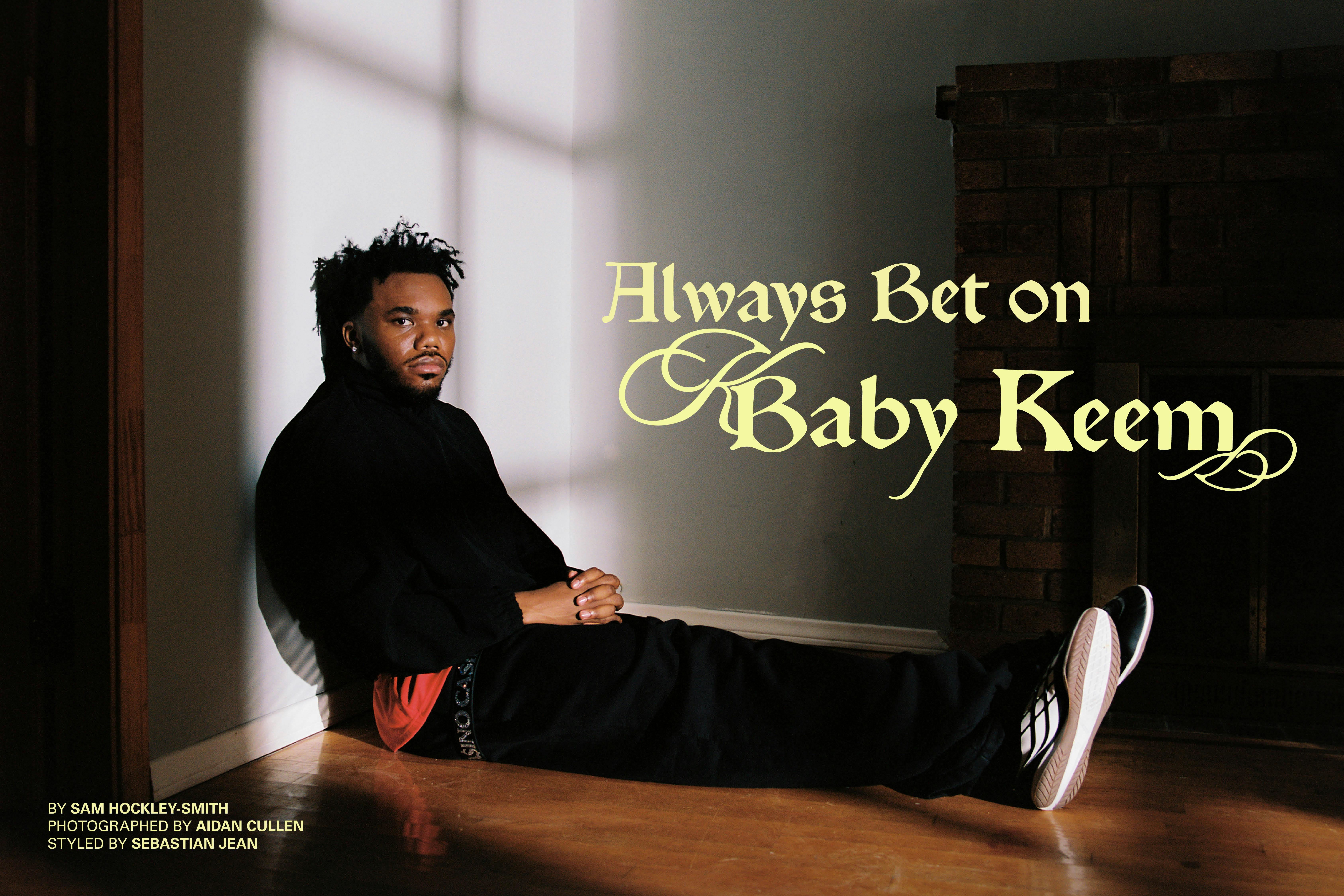
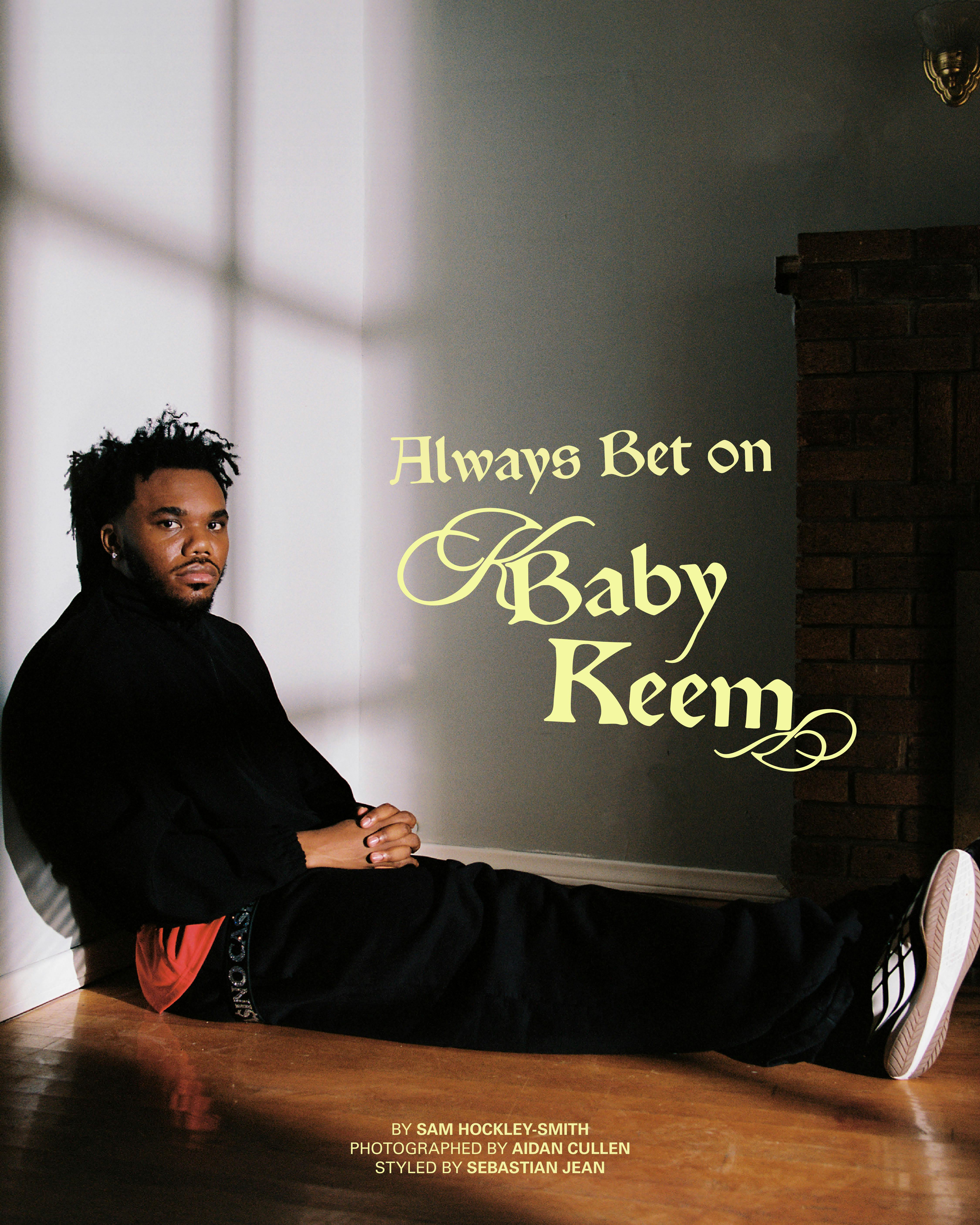
Top and shoes ADIDAS, jacket and pants FEAR OF GOD, belt Keem’s Own
Highway 95 is the longest highway in Nevada. Stay on it in either direction, and you’ll leave the state. Keep going, and you’ll eventually be in a different country. It’s reasonable to assume that most people who’ve spent a good chunk of time in America have touched at least some part of it. But the 15 or so miles that run right through Las Vegas hold deep meaning for Hykeem Jamaal Carter Jr, a.k.a. the Grammy-winning rapper and producer Baby Keem, first cousin once removed of Kendrick Lamar, master of the helium-voiced flow and whiplash beat switches that turn virtually every one of his songs into mini-epics.
Keem has made two songs about that stretch of highway: The Melodic Blue’s “Highway 95” and its brooding sequel, Ca$ino’s “Highway 95 Pt. 2,” which was released after he took a five-year break from music. In the first, he’s speeding down 95 on the way to meet a girl. His transmission goes out, and it takes four days to get it fixed. The highway represents a path to his independence, but he can’t keep his car in good enough shape to get anywhere.
In the sequel, 95 becomes the center of Keem’s universe. When he has no shelter, he sleeps under it. When he has somewhere to be, he hitchhikes with five bucks to chip in for gas. The highway reminds him of where he came from, that he feels like he’s failing his family, and his family is failing him. How he’s pretending to be someone he’s not in order to survive.

“I knew I would eventually have to address Vegas,” the 25-year-old tells me the day after performing the second of two sold-out shows in Los Angeles. In person, Keem is deeply engaged and open. You get the sense he’s turning over every question in his mind to answer honestly. Often, artists come into an interview with an agenda — How can I make sure my answers connect to whatever I’m trying to achieve? — but for Keem, whose warm smile explodes off the sides of his face, it’s more of an exploration. Another chance for him to better understand himself and his art. “I just didn’t know it was going to come out like this,” he continues. “But when you really dig deep — and I was digging deep, deep — through some of these ideas, it was clear that being from this place was the root of a lot of these concepts. My mom didn’t start using substances until we moved to Vegas. I didn’t really think the world of Vegas at the time. I have a different relationship with it now. My grandma passing and things like that…it hurts going back,” he continues. “Vegas is hard for me. I still have some family there, but it’s tough.” Keem’s grandmother died in early 2025, and although her death isn’t the direct inspiration for Ca$ino, it hangs over every song, every interview, and every performance.
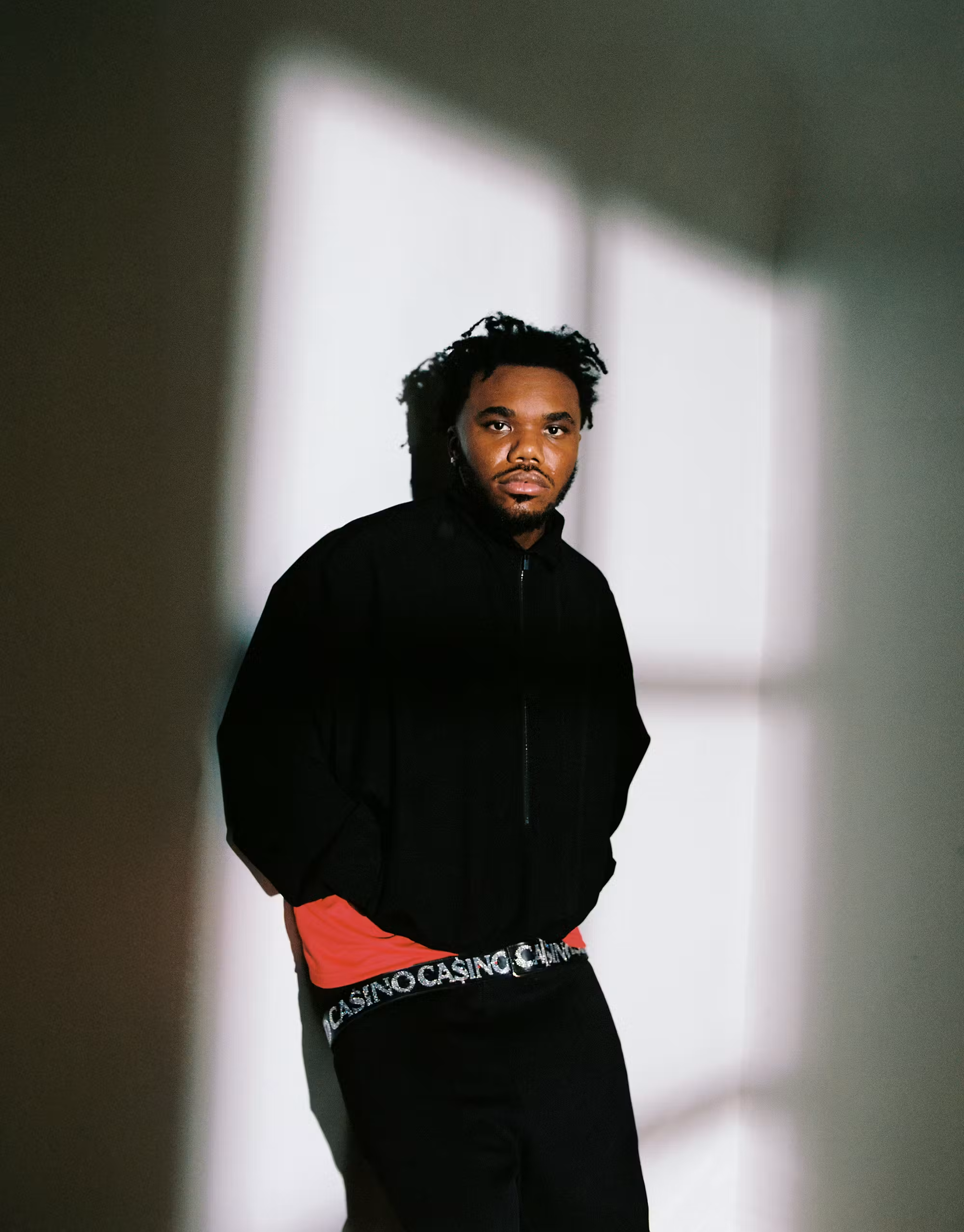
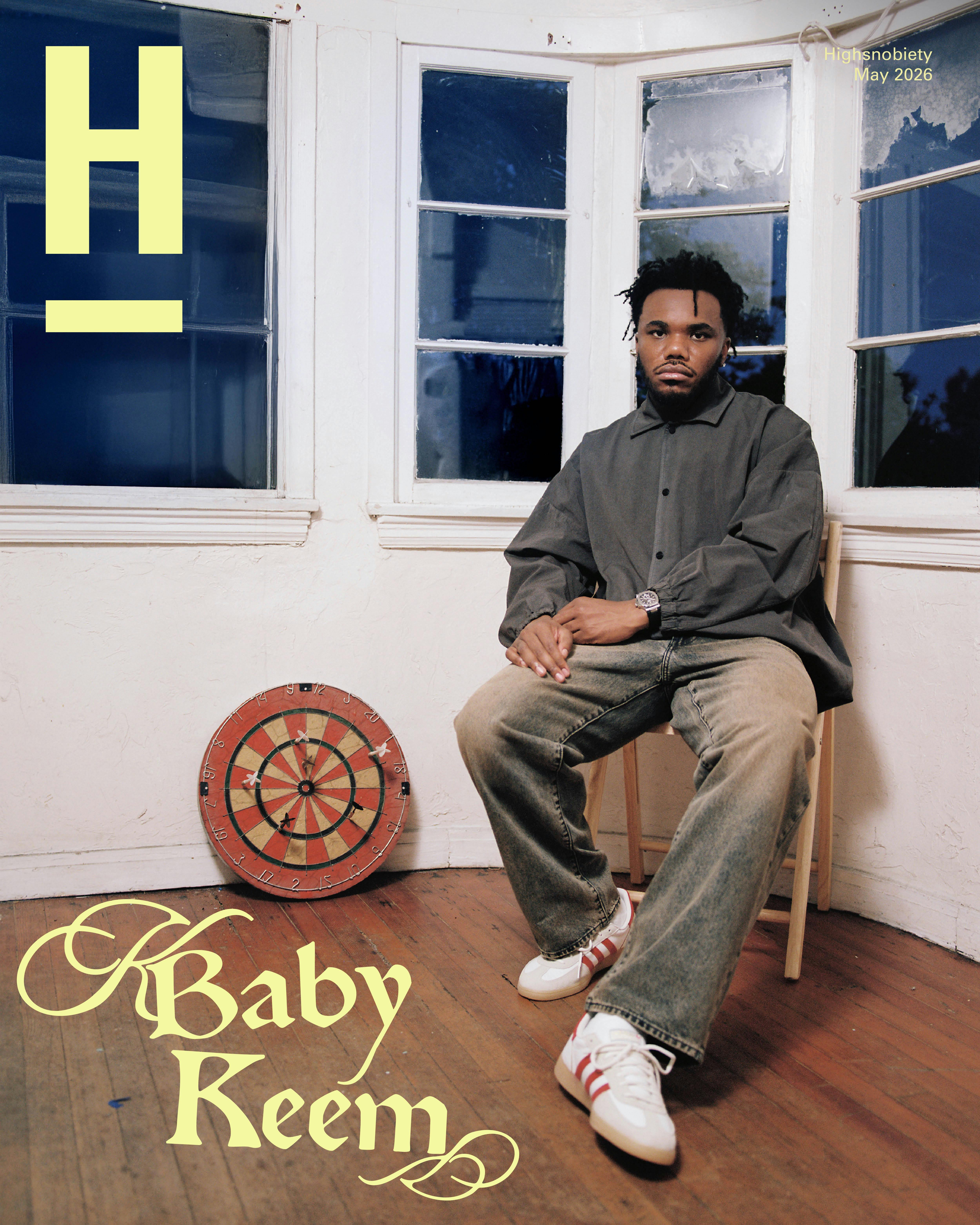
Top and shoes ADIDAS, jacket and pants FEAR OF GOD, belt Keem’s Own
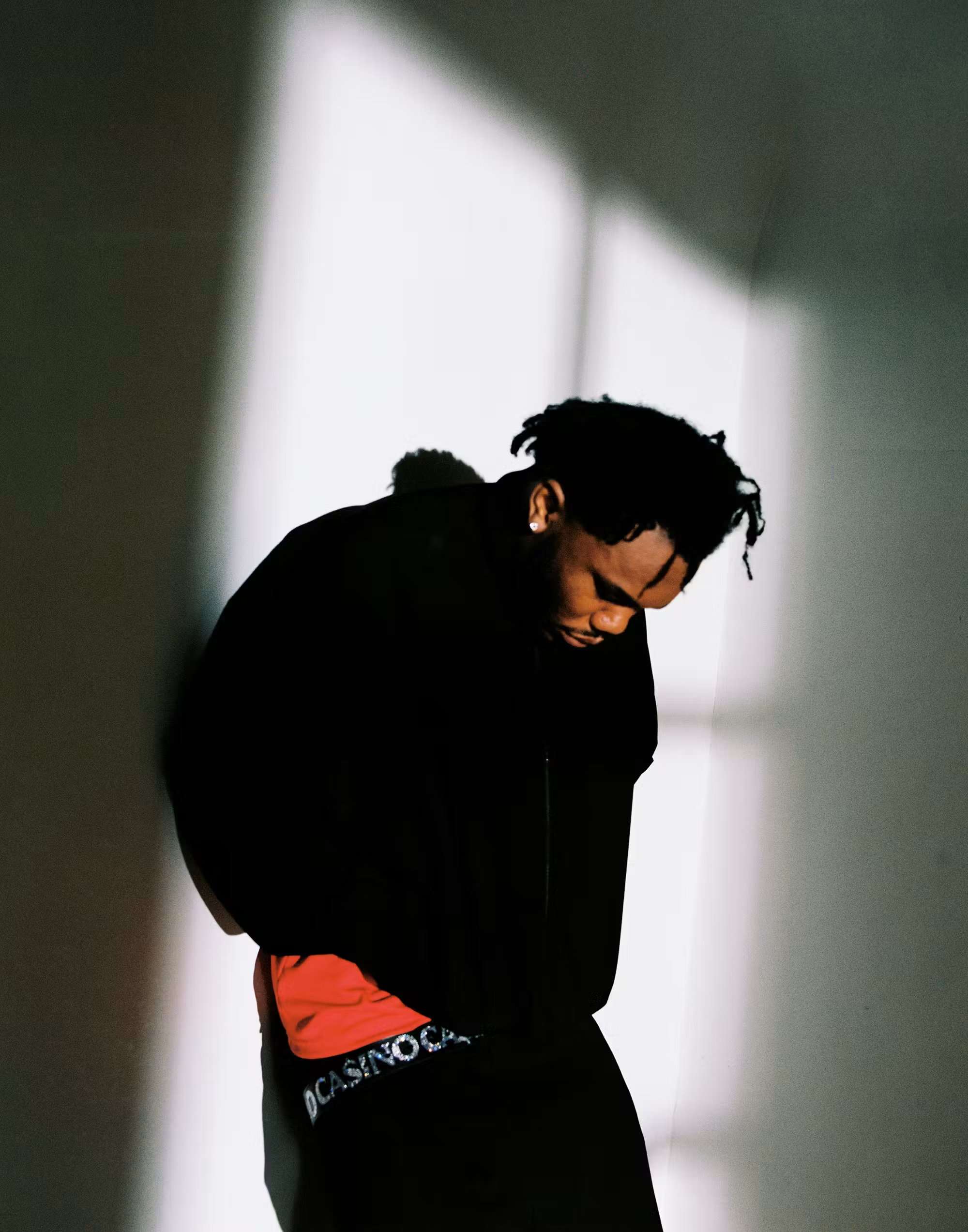
These days, Keem is always moving. His tour brings him to a new state almost every day. Peppered between shows he has promotional requirements, meet-and-greets, and the ever-present lure of artistic creation dividing his time. But each night, he gets up on stage, virtually alone for most of the show, and re-lives some of the hardest moments of his young life on perpetual loop.

When he was little, Keem and his mom moved from Long Beach to Las Vegas to be closer to family. Keem’s grandma and his aunt Connie and uncle Gerrell were out there. There was music and laughter, but there was addiction and chaos and the attendant lure of gambling to contend with, too.
Keem’s mom was frequently absent; his aunt and his grandmother took on the caretaking duties. When Keem was six, he was briefly placed in a group home. “I walked in…there were these bunk beds. It was dark. All the kids are whispering like, ‘New kid. New kid. New kid.’ I go to sleep. I wake up, and kids are going to school from here. I’m like, where is my grandma? People are living here. What’s happening?” Keem recalls. “I remember crying that whole day.”
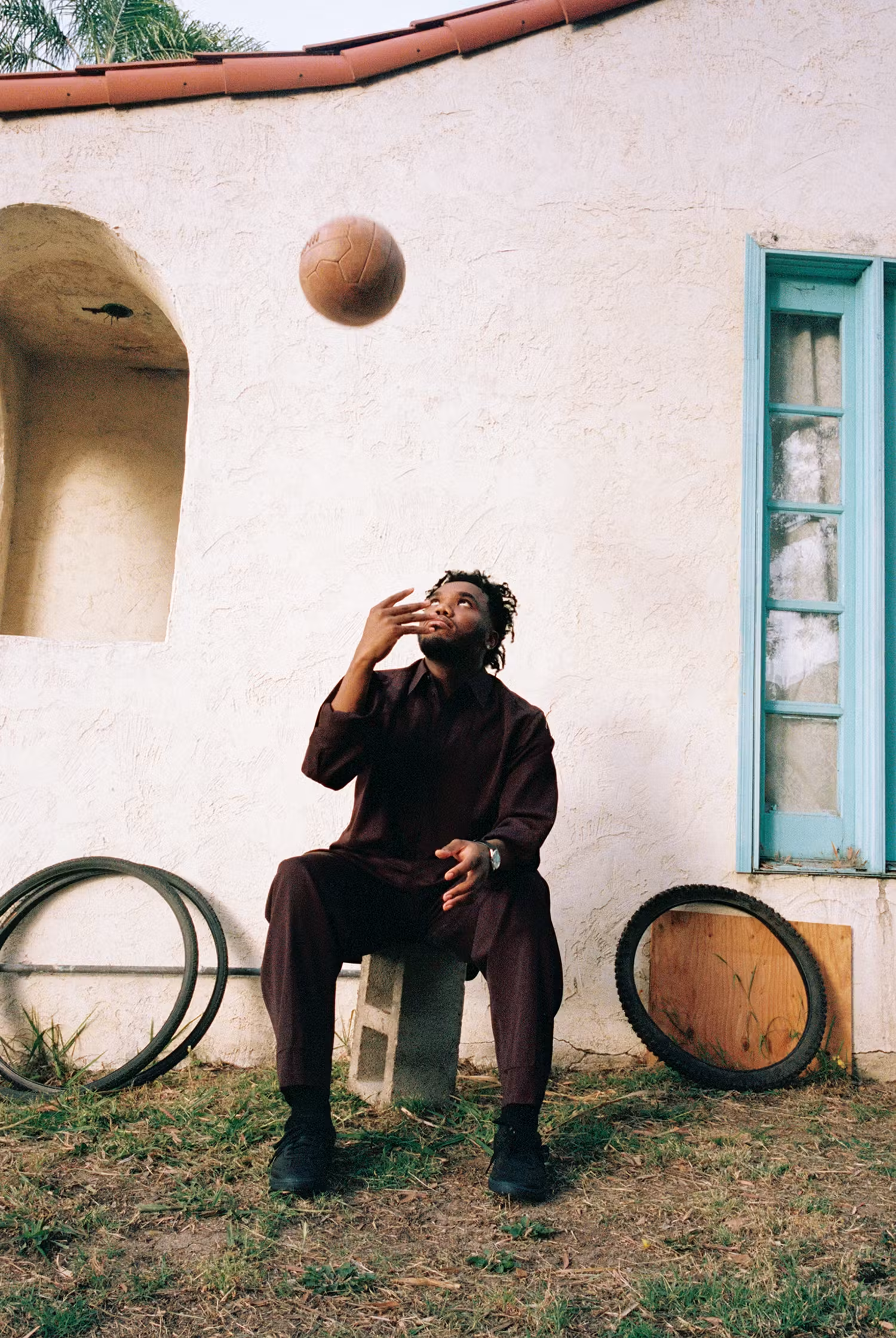
Top and pants BOTTEGA VENETA, shoes ADIDAS, watch ROLEX Keem’s own, necklace Keem’s own
He relays this part of the story in…not a lighthearted manner exactly, but when you’ve been through tragedy there’s a certain tenor dark stories can take — a can you believe how insane this is? tone that acts as a shield from embarrassing displays of pity, or a code for those who’ve experienced similar trauma. Then, harsh reality seeps back in: “This kid tried to comfort me. He was eight or nine. He was rubbing my back. We were playing Jenga. He was like, ‘Look, at least you have a home to go to. Some of us never get to go home.’ That always stuck with me. I did go home. Connie came and got me.”
Keem sought normalcy with his aunt and uncle and grandma. Like other kids his age, he loved basketball. Video games were a constant, too. He’d spend unhealthy quantities of time gaming with friends, talking shit on Skype while swapping Minecraft tips or playing FIFA. “When I was like 12, I started playing online games, and I found FIFA,” he says. “That’s when I realized how good Neymar was. Like, 2012 Neymar? That’s beautiful.”
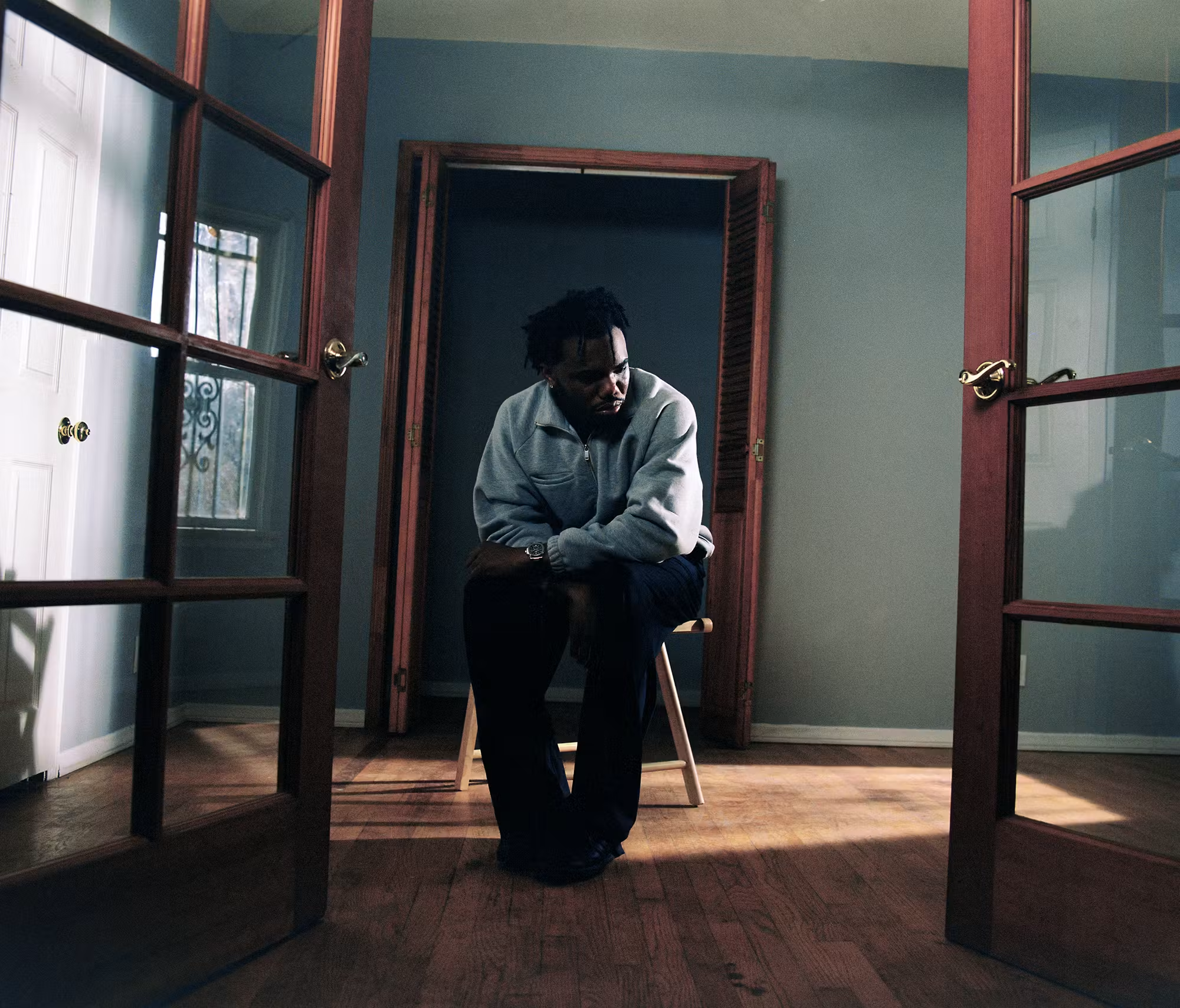
Top SWEATS, pants GUCCI, shoes ADIDAS, watch PATEK PHILIPPE Keem’s Own
A bunch of his friends were really into soccer so he watched them play. Then, he got in the mix himself. “I was like, ‘This is tactical, but this is also individual skill. This is everything,’” he says. “I watched Mesut Özil play. That’s how I became an Arsenal fan. He’s so good that he has a play style, which is like…you have to be double great. In music terms, that's like the greatest rapper making a [great] rock album. This guy is like, ‘I’m going to be unselfish. I’m not going to be known as this [one thing], but I can do all of these things.’ He makes the game look beautiful. He exemplifies what the sport is to me.”

It makes sense that Keem would admire a player who could do it all: be the star, but also blend into the background for the good of the team. From the beginning, his approach to music was similarly collaborative. He thought maybe he’d like to rap, but he couldn’t find any beats to rap on, so he started to make his own. His friends caught on, and “it kind of gamified making music,” he says. The marathon gaming sessions turned into marathon discussions about what they’d learned, or some new way to use a plug-in.
The group built an artistic bond that was shielded from the rest of the world — until it wasn’t. “I started releasing music my freshman year. I remember being crucified…not crucified, but, well…a little bit crucified.” Keem smiles that miles-long smile, referring to the awkward period of teenage life when it feels uncool to try something new, to actively work toward a future. “People would make fun of it, but then you’d have the people who were like, ‘Oh, this is super cool.’ Those are the people I'm still friends with. By my junior year, all those kids who made fun of it would end up doing it.”
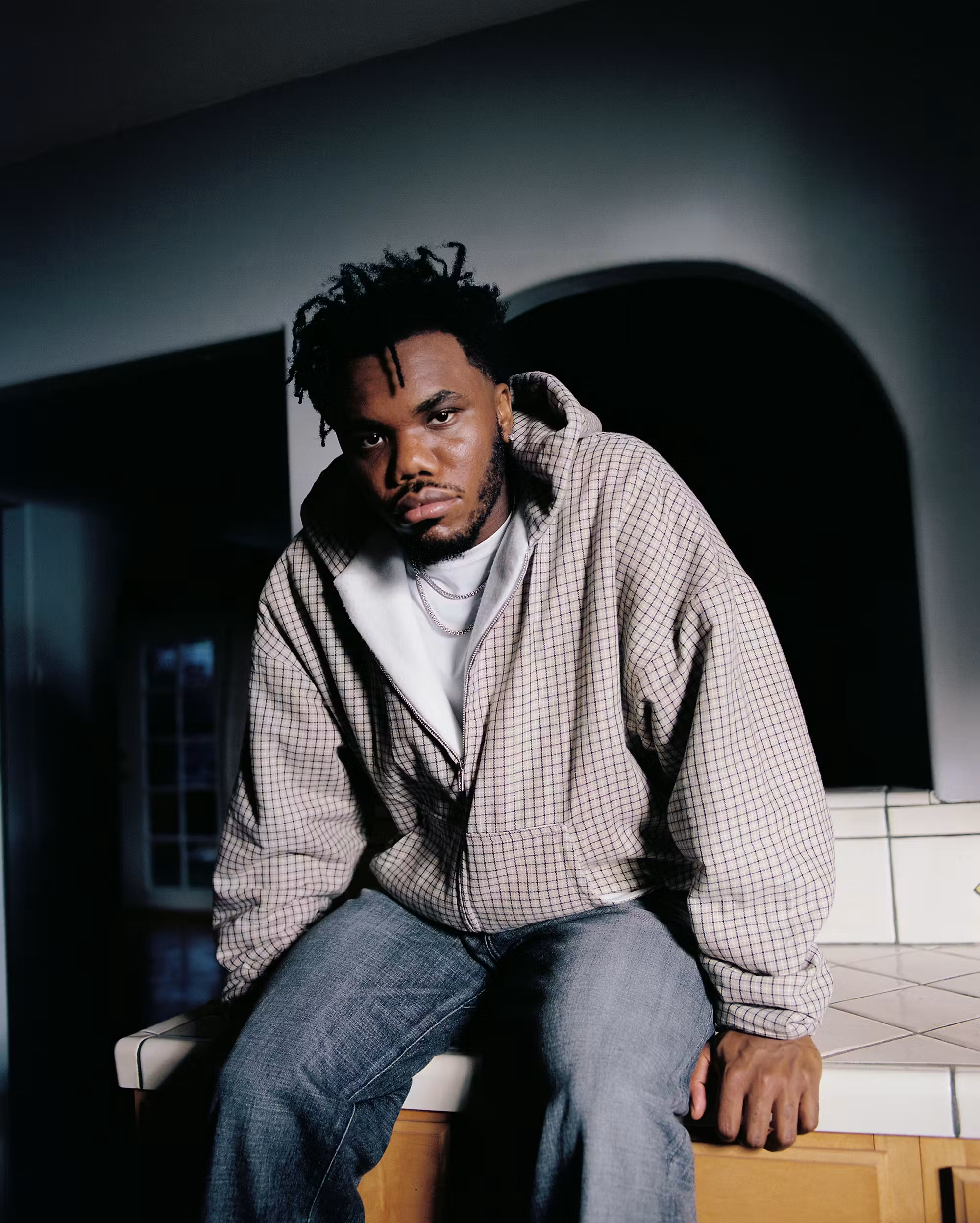
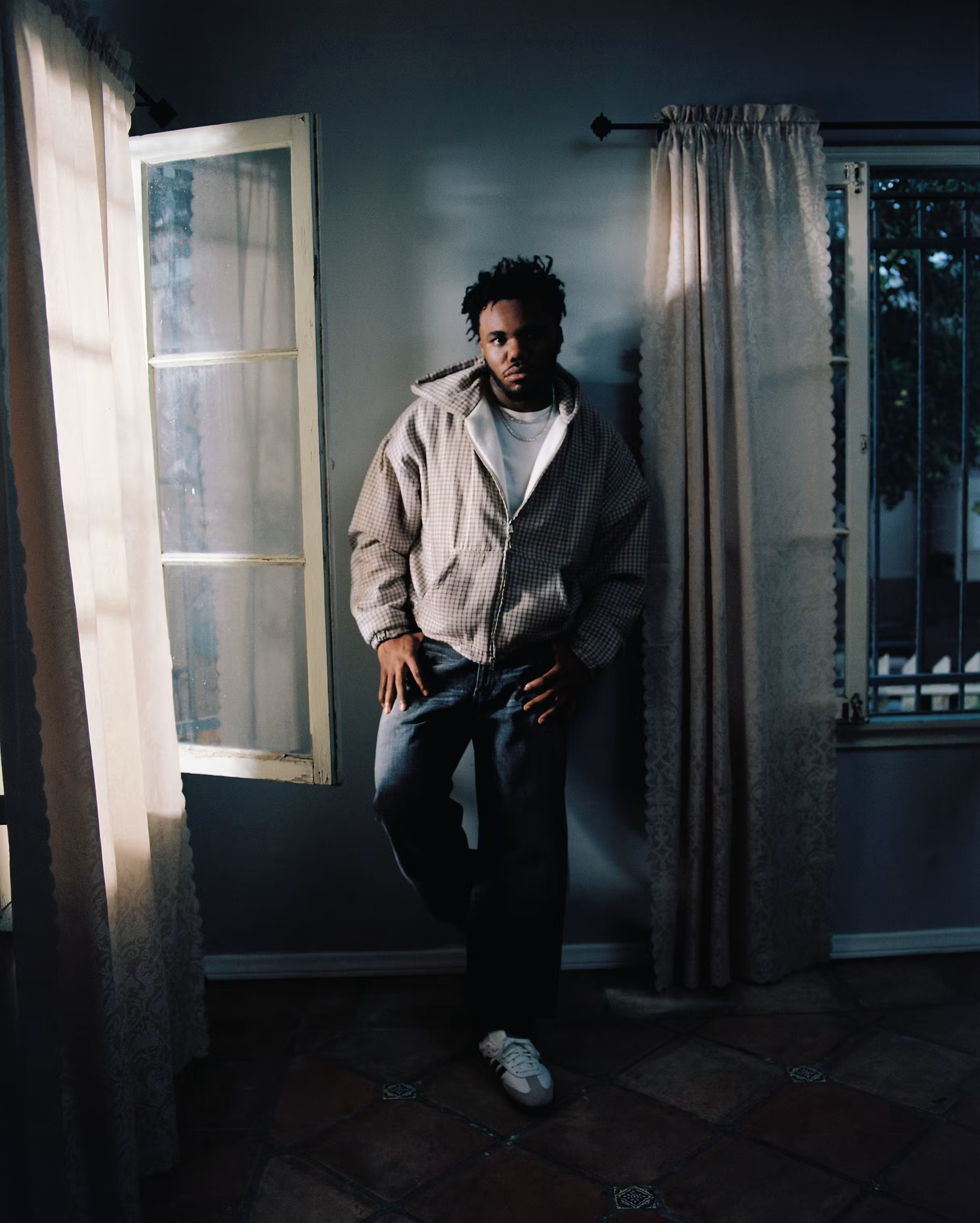
Top COS, hoodie SWEATS, pants NANAMICA, shoes ADIDAS
In 2015, Keem’s uncle was hit and killed by a truck. A lot of Keem’s extended family came out to the funeral, including some members, like Kendrick Lamar, whom he hadn’t kept in close touch with. He was just a teenager standing up there trying to get through his eulogy. Kendrick took notice and asked Keem to come out to LA. “Kendrick asked me, ‘Do you want to be a rapper, or do you want to be a producer?’” Keem recalls. “In my head, I was like, ‘I am a rapper.’” Keem started getting gigs producing for other artists in Kendrick’s orbit like Schoolboy Q and Jay Rock.
There’s this photograph of a 16-year-old Keem and Kendrick that circulates online every so often. They’re crammed into a makeshift studio on a tour bus. Kendrick’s got his hood up, headphones on, a loose grip on a microphone. A young, bespectacled Keem is wearing a crisp white DAMN. shirt. He’s hunched over a laptop staring intently at the screen. “That was just me and him on a tour bus at 2 a.m.,” Keem says. “I came to tour after school finished. I would have my Jansport backpack, I would have my Audio Technica AT 2020, and I would have a computer. I would go on [Kendrick’s] bus, and I would just bug him. Literally, ‘Yo, here's my mic.’ That handheld mic that he's holding in that picture? It’s a $100 mic that my grandma bought. And then I would just play shit, just make stuff, make stuff, make stuff.”
Keem would probably tell you that it worked out for him because he was always ready to get in where he fit in—on time and without ego. But Kendrick also intuited that Keem could be a real cultural force. What Kendrick saw in Keem at his uncle’s memorial was someone who reminded him of himself. Kendrick wrote to The New York Times that Keem was “[a reminder] of all the realities I faced which shaped who I am today. I watched Keem carry the burdens of everyone’s grief, including his own, all while maintaining the dignity and honor of his uncle. We’re merely a reflection of our leaders, and Keem led the family to a place of love, compassion, and closure.”
Since those early days with Kendrick, Baby Keem has honed his sound into a weird jumble of hyperactive rage rap juxtaposed with deeply candid and vivid recollections of his tumultuous life in Vegas — often on the same song. When he performs live, kids mosh to startling moments of lyrical whiplash: Keem moves seamlessly from bragging about his newest car to asking — no, threatening — to punch you in the face. Then he’ll throw in a line about his mother’s addiction, or what it was like to grow up without knowing if you’d have somewhere to sleep. His great feat is that, rather than allowing these emotional poles to cancel each other out, he lets them feed each other. It’s sometimes jarring, but it’s real. A contradictory portrait of a guy who has experienced more death and pain in his young life than anyone should have to experience ever.
In fact, the previous decade of Keem’s life contains so many ups and downs, famous collaborators, pivotal career moments, and sold-out tours, that it can be hard to find space to pierce the surface. That’s part of the point of Ca$ino’s candidness, and definitely the point of Booman, the three-part documentary about Keem’s early life, made up primarily of footage that Connie shot over the years. “I remember growing up with the camera,” Keem says. “But there was a point where I got conscious of it. It was a big staple of everything we would do. She wanted to be an actress.”
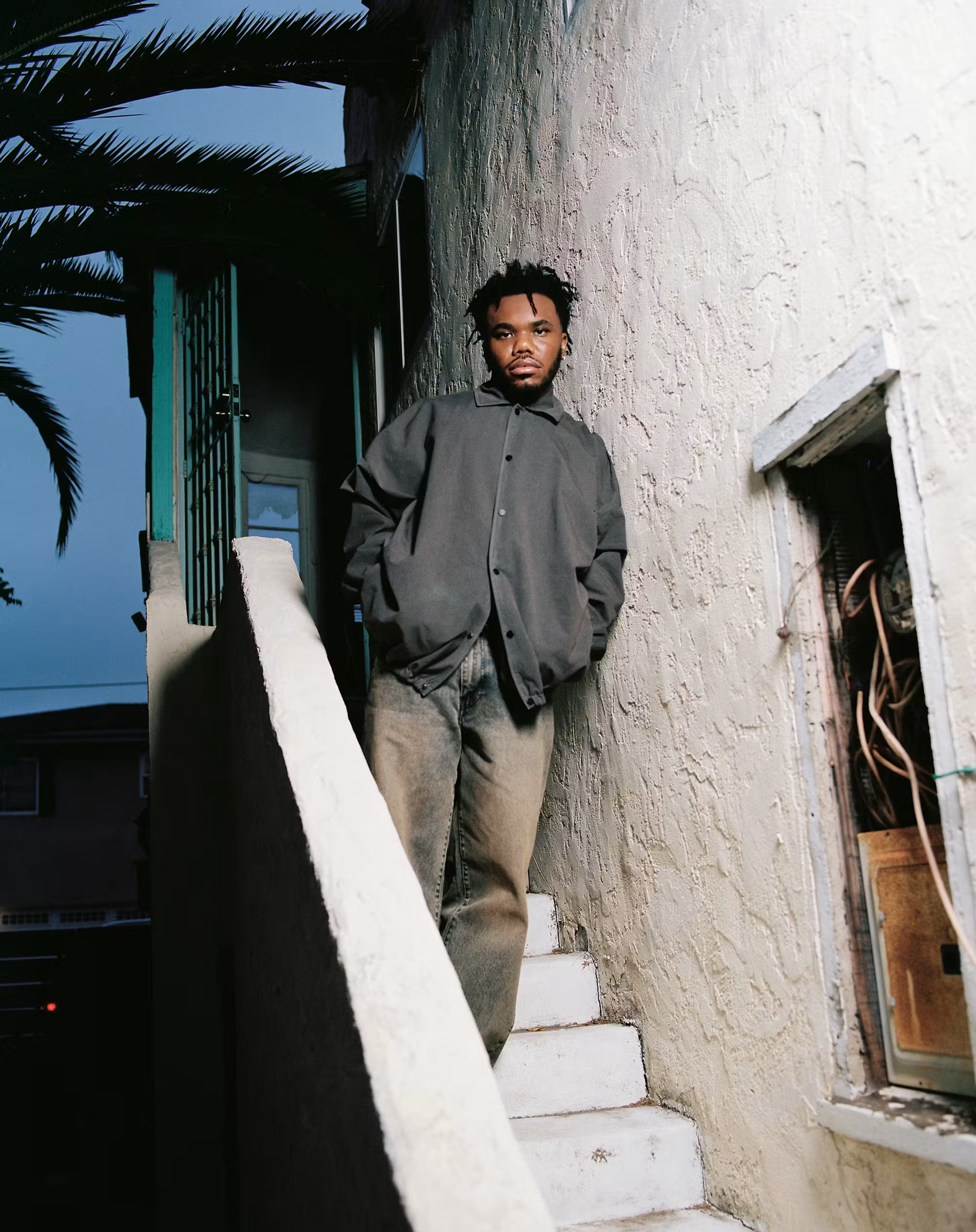
Jacket FEAR OF GOD, pants LEVI’S, shoes ADIDAS, watch PATEK PHILLIPPE Keem’s own
At a tight eleven tracks, Ca$ino is a shockingly direct album about poverty and addiction. Plumbing the tumult of the past isn’t exactly rare for an artist, but we’re still living in a world of therapy buzzwords masquerading as insight. Keem circumvents this by avoiding obfuscation, speaking clearly, while never falling into hackneyed redemption narratives. On the album opener, “No Security” he flips the rags-to-riches arc we’ve come to know. Rather than celebrating his new station, he’s dealing with the same shit, except the stakes are higher: “Understand what it takes just to reinvent the flame / I came back different with a sound to bring change / 19 with some millions things began to turn strange / my momma looked at me just like she going to the bank.”
As a producer, Keem has always oscillated between hyperactive fight music and soul-probing intimacy, but he takes it to another level here. He builds out an entire world with his tight-knit team of co-producers, including frequent Kendrick collaborator Sounwave, stalwart writing and producing partner Scott Bridgeway, and Danja, the veteran producer who cut his chops working with Timbaland during the FutureSex/Lovesounds and “We Takin’ Over”-era of slow-rolling tranced out hip-hop opulence.
As much as the album is getting attention for tracks like “Blame,” a nuanced meditation on his relationship with his mother built in a jagged chop of a sample of James Blake crooning “I don’t blame you,” or “I am not a Lyricist,” which features Keem’s voice as a melancholy croak reminiscent of Andre 3000’s more intimate verses, or the endearingly goofy love song “Good Flirts,” featuring Kendrick Lamar and Momo Boyd, it’s also getting attention because it was released five years after Keem dropped The Melodic Blue and then virtually disappeared from the industry due to health issues he doesn’t like to speak about much.
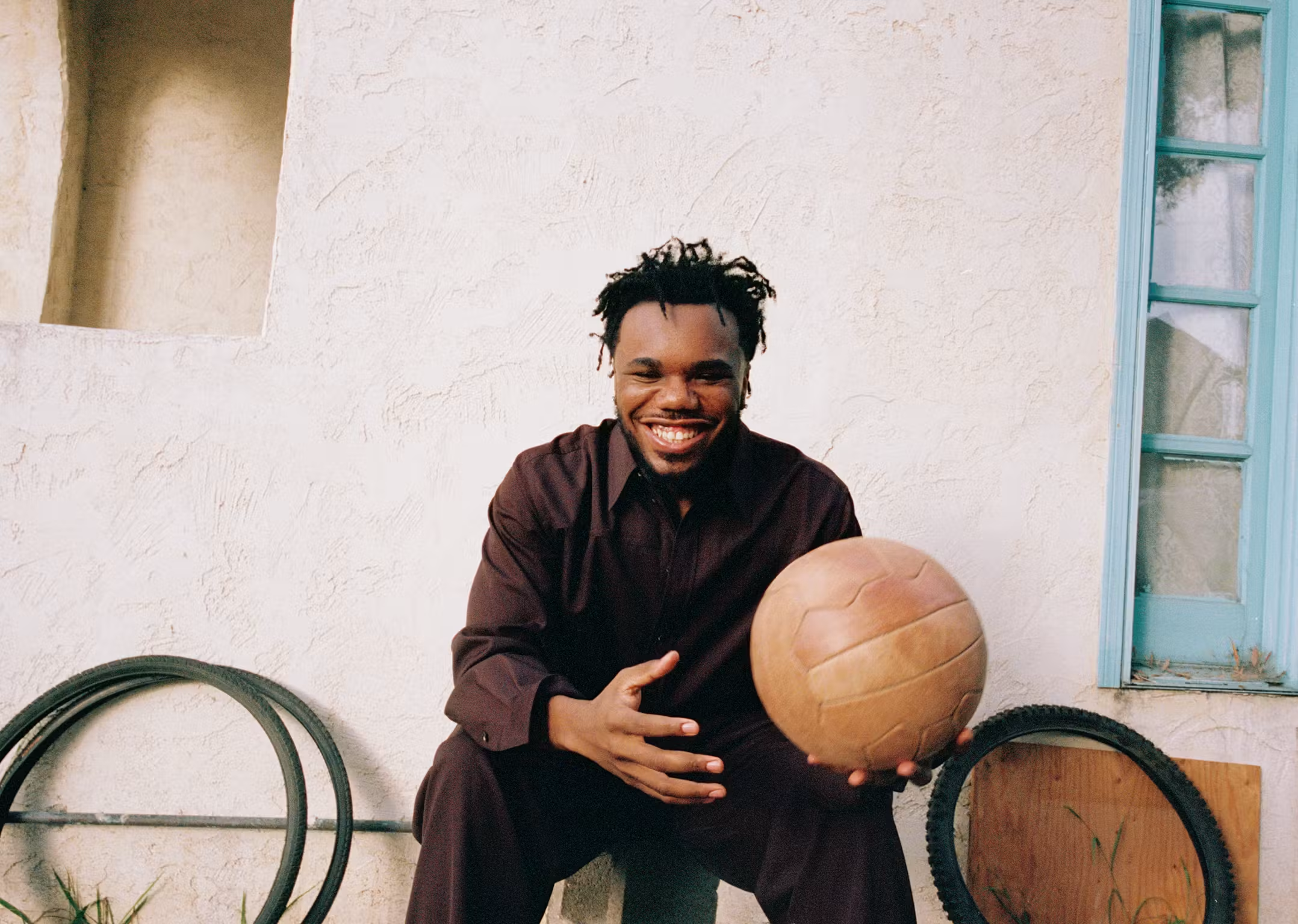
Top and pants BOTTEGA VENETA, shoes ADIDAS, watch ROLEX Keem’s own, necklace Keem’s own
“I’ll never be super public about what it was because I don't want that to be the narrative,” he says. “Going through that was the hardest setback for me. You have all these [moments] where you’re like, ‘Damn, I really won’t make music ever again.’ I turned off my Twitter. I didn’t need to see people telling me to release when I physically could not make music for a year. I had to learn how to do it again. It really fucked me up to where I didn’t want to go outside at all.”
Keem’s long absence was so commented on by fans not just because it came out of the blue, but also because of when it happened. The Melodic Blue was a massive artistic and commercial success. “Family Ties” won a Grammy. Keem had carved out a lane that, for the first time, felt truly his own, making music that was hyperactive and warm and funny and sometimes dark. It was daring and unpredictable. Real. Fans had developed a relationship with it, finding comfort in the stray lines that gestured at Keem’s past, seeking strength in the moments that sounded like a hulking robot destroying every building in a town full of people who used to doubt you.
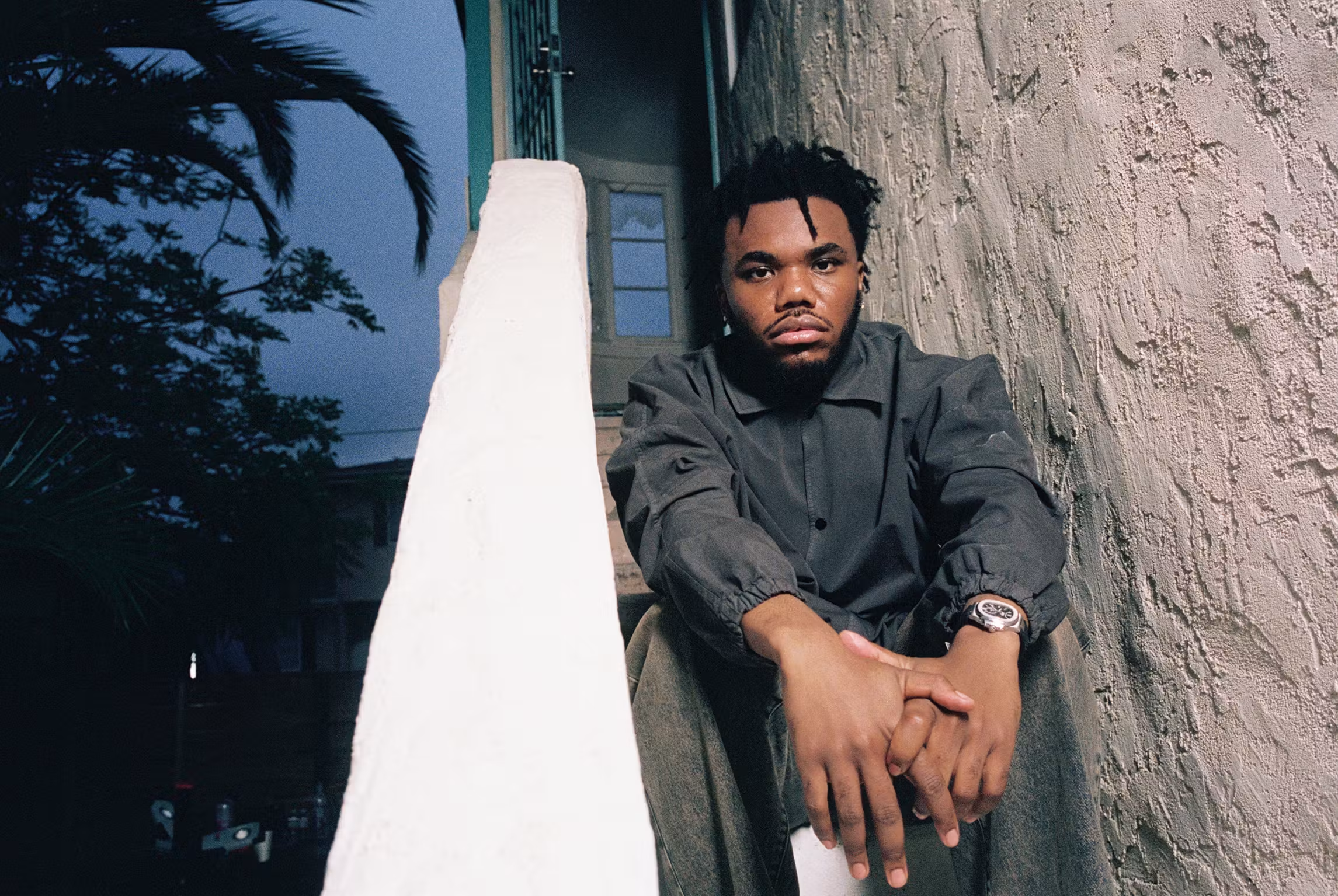
Jacket FEAR OF GOD, pants LEVI’S, shoes ADIDAS, watch PATEK PHILLIPPE Keem’s own
At a recent sold-out show in LA, it was immediately clear how important Keem’s story — not just his music, but the whole package — is to all these kids. They feel a connection that transcends regular fandom when they hear his new music, or when he’s alone on stage commanding them to completely lose their shit, or keep still while he gets serious for a minute. They show up in their Baby Keem Ca$ino tour shirts, ramming into each other in animal costumes, moshing to nothing but the sound of Keem talking. It’s all important not because they think they could one day be Keem, but because his story — strings of tragedy followed by a success too wild to even dream of — means that sometimes, once you wade through the bullshit, you actually can end up somewhere great.
One of the reasons “Highway 95 pt 2” is such an album highlight is because it feels like a concentrated version of Keem’s story. The highway acts as a metaphor for upward mobility while also literally being the path away from his circumstances. He’s getting somewhere, then being called back. Now, Keem is closing the loop. He’s told us where he came from, what he’s been through, and where he wants to go next. And we get to watch him do it.
Credits
By: Sam Hockley-Smith
Barber: Marcus Hatch
Photographed by: Aidan Cullen
Groomer: Amber Amos
Styled by: Sebastian Jean
Head of Client Services: Johanna Laura Gerhardt
Nails: Michelle Nyugen
Photo Assistant: Liam Cavanaugh
Gaffer: Derek Perlman
Set Design: Andrew Caso
Styling Assistant: Melina Suriani
Production: Manifestation Inc
Producer: Brandon Zagha
Production Assistant: Angust Senter