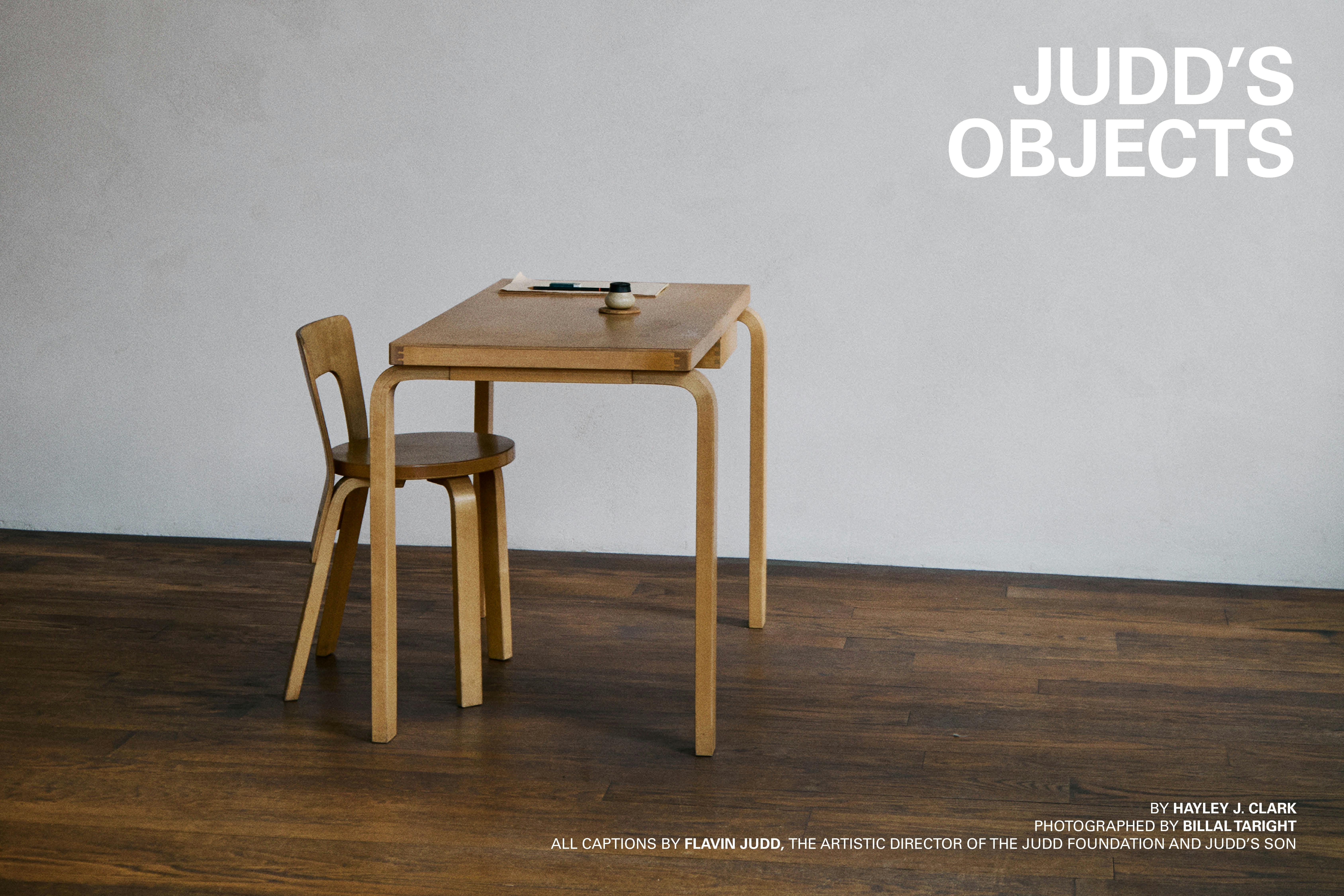
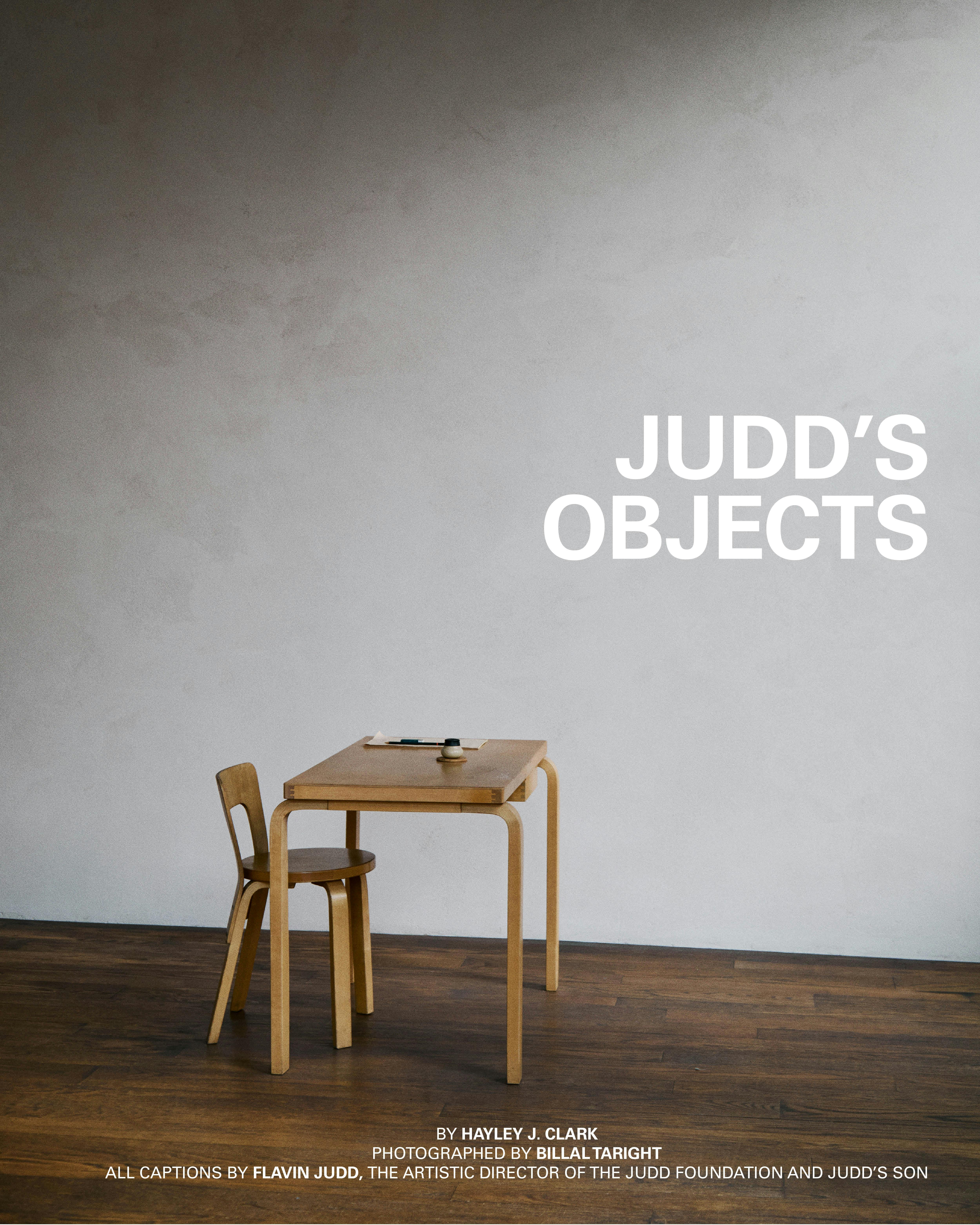
“This desk and chair, both designed by Alvar Aalto around 1930, was installed on the third floor only after Rainer and I had grown up.”
On the corner of Spring Street, and Mercer Street in Manhattan sits an absolute marvel of New York City architecture. The five-story cast-iron building, built in 1870, was the residence and studio of the monumental American artist Donald Judd. He purchased the former factory in 1968, when artists began flocking to SoHo for the abundant cheap real estate, and lived and worked there until the end of his life in 1994. Today, the Judd Foundation, managed by Donald’s children, Flavin and Rainer, maintains the space just as Donald left it, as a museum and office.
While Judd’s legacy as an artist and designer continues to have major cultural impact — most notably, perhaps, as the mastermind behind the development of Marfa, Texas, where he started the sprawling Chinati Foundation for large-scale artworks and his own architectural fantasies — what’s most interesting about visiting 101 Spring Street is the close encounter one gets to have with his personal things, which still remain in the places he left them. Don’s stuff.
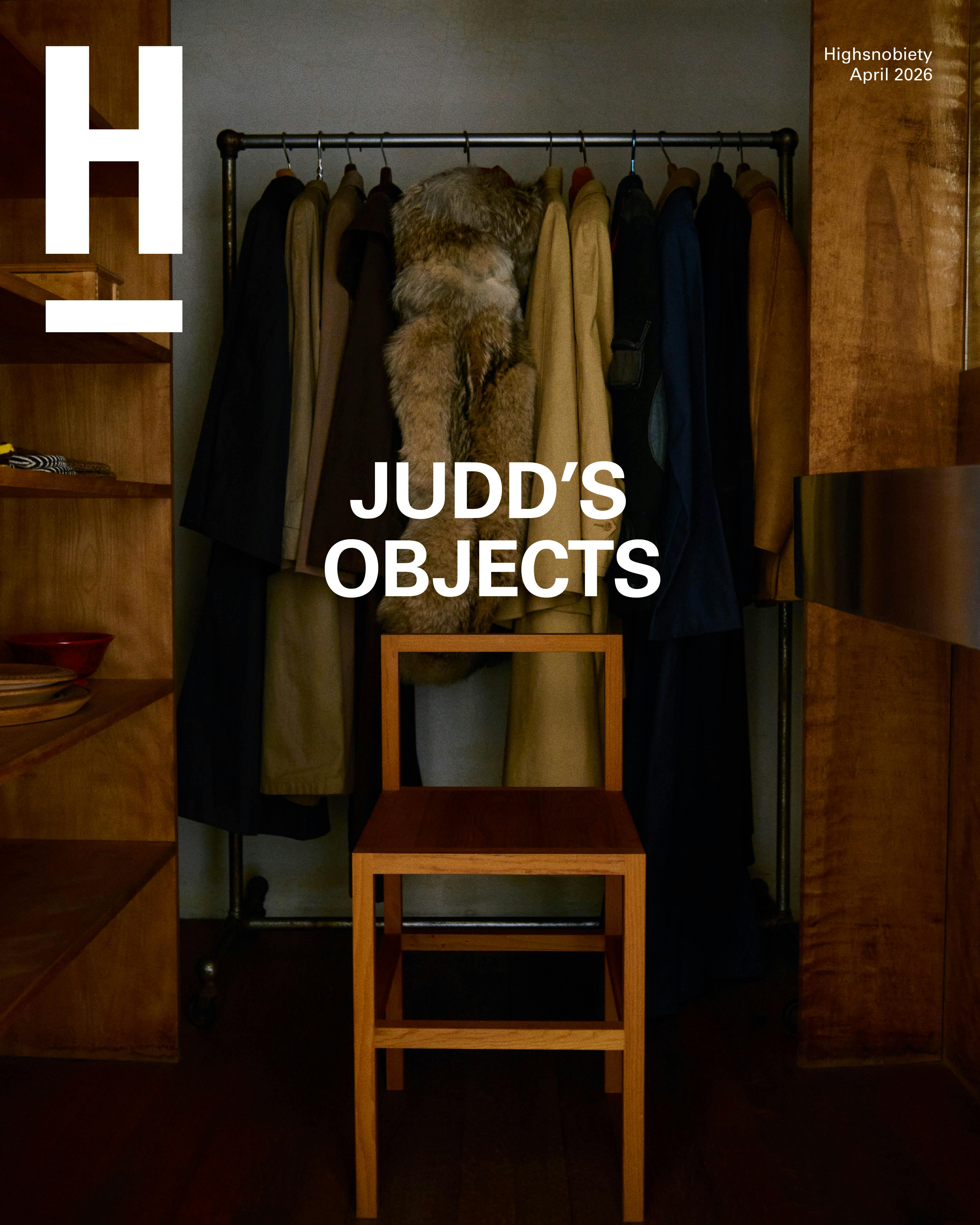
“Don liked simple and natural fabrics, lots of work clothing, never suits. He wore the fur coat occasionally, when New York used to get below zero. I was told it was wolf fur, but I don’t really know; it’s from the early 1970s so it is now vintage.”
According to his son, Flavin, Judd thought domestic objects were “important because that’s what you look at everyday. You handle them; you’re familiar with your coffee cup. If it’s something you’ve not considered, then you’ve lost an opportunity to pay attention to the world around you.”
Earlier this year, I visited to see what I could learn about how Judd considered the world.
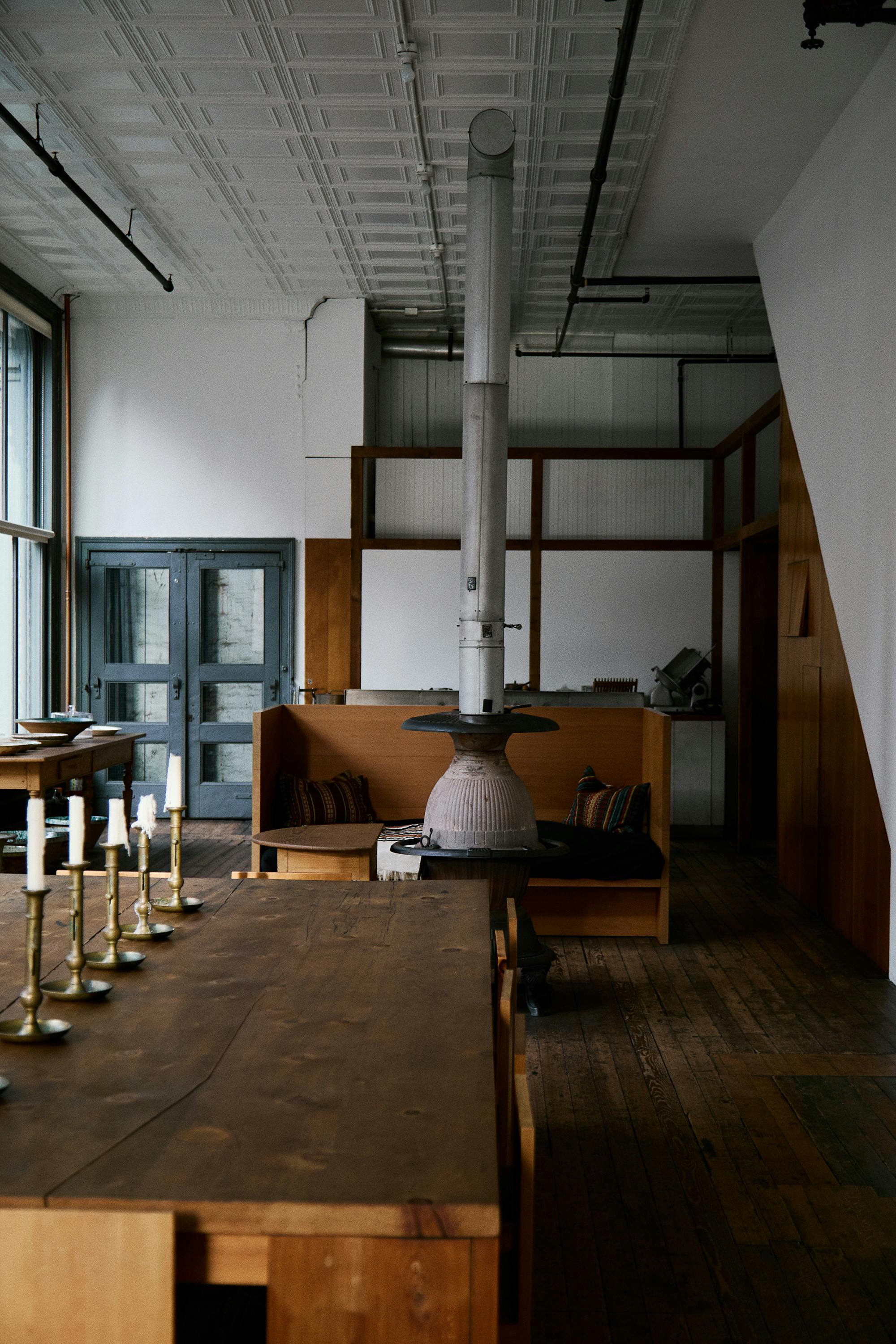
“Don hated machines. Some weren’t horrible to look at, but in general he hated how they were designed. Fortunately, all the old cast iron wood-burning stoves look pretty good. This one is the Station Agent model by Union Stove Works from the late 19th century. The dining chairs and table were designed by Don in 1982.”
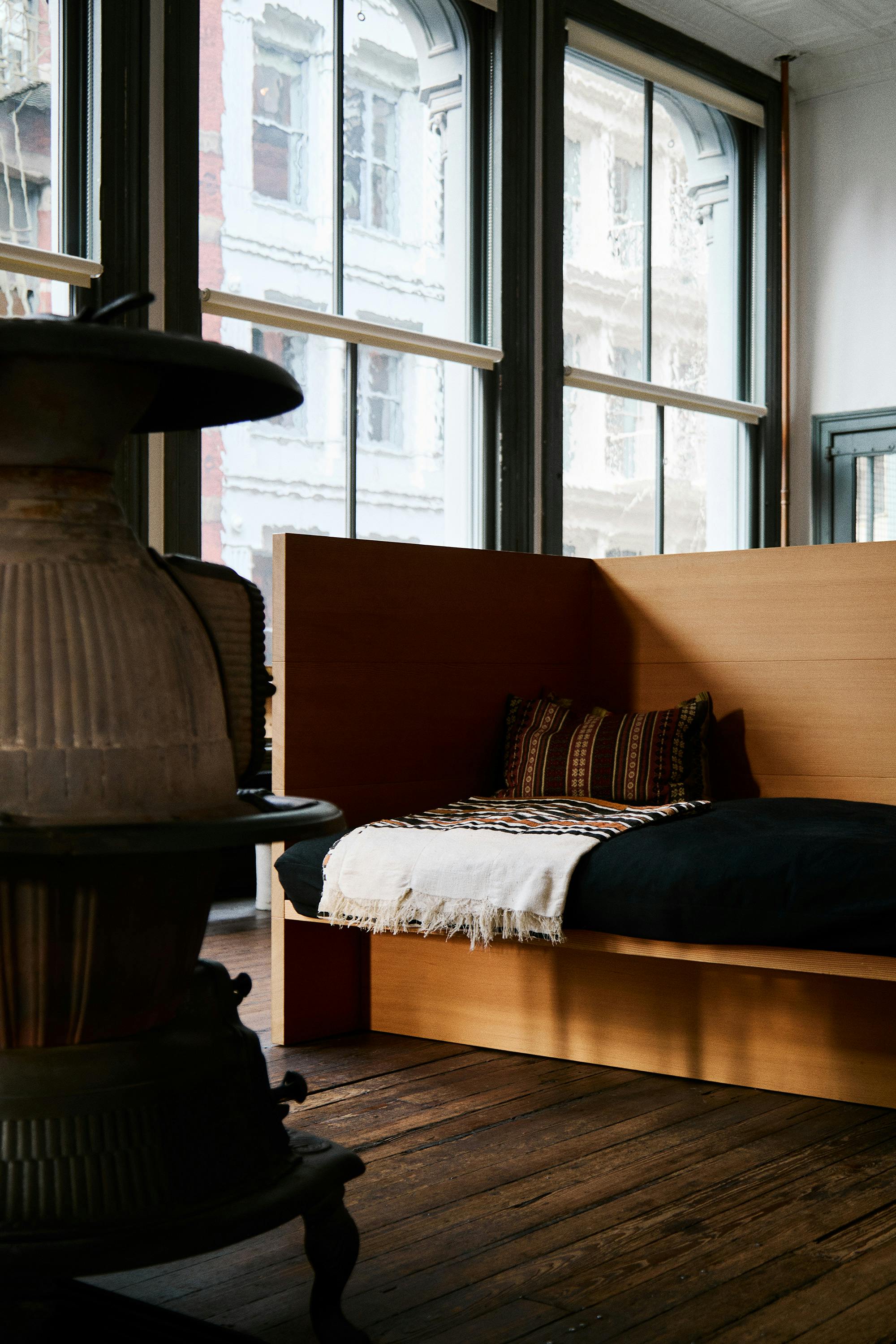
“Almost all the spaces in the home have a place to sit; some also have a place to lie down. It just makes life more enjoyable. This daybed is Douglas fir and was designed by Don in 1978. He liked textiles that were made as part of a cultural heritage — they were almost always of non-American or non-European craftsmanship. He preferred geometric designs and muted colors.”
The first floor is a gallery space with high ceilings, white walls, and scarred wood floors. When Judd bought the building, a former factory, he stripped it to its bare elements. His technique has been taken up by present-day designers, evident in the preference for exposed beams. It might be an exaggeration to credit Judd with inventing the fetish for original hardwood floors, but he was certainly an influence.
Upstairs, the living quarters have a similar white-cube quality, but with signs of habitation: a low daybed, a simple kitchen, and an enormous wooden dining table. Judd left the floor-to-ceiling windows uncovered, preferring unmediated light. The brightness and calm give the room a sacred feel. One becomes acutely aware of the air, the proportions, the sound of one’s own footsteps.
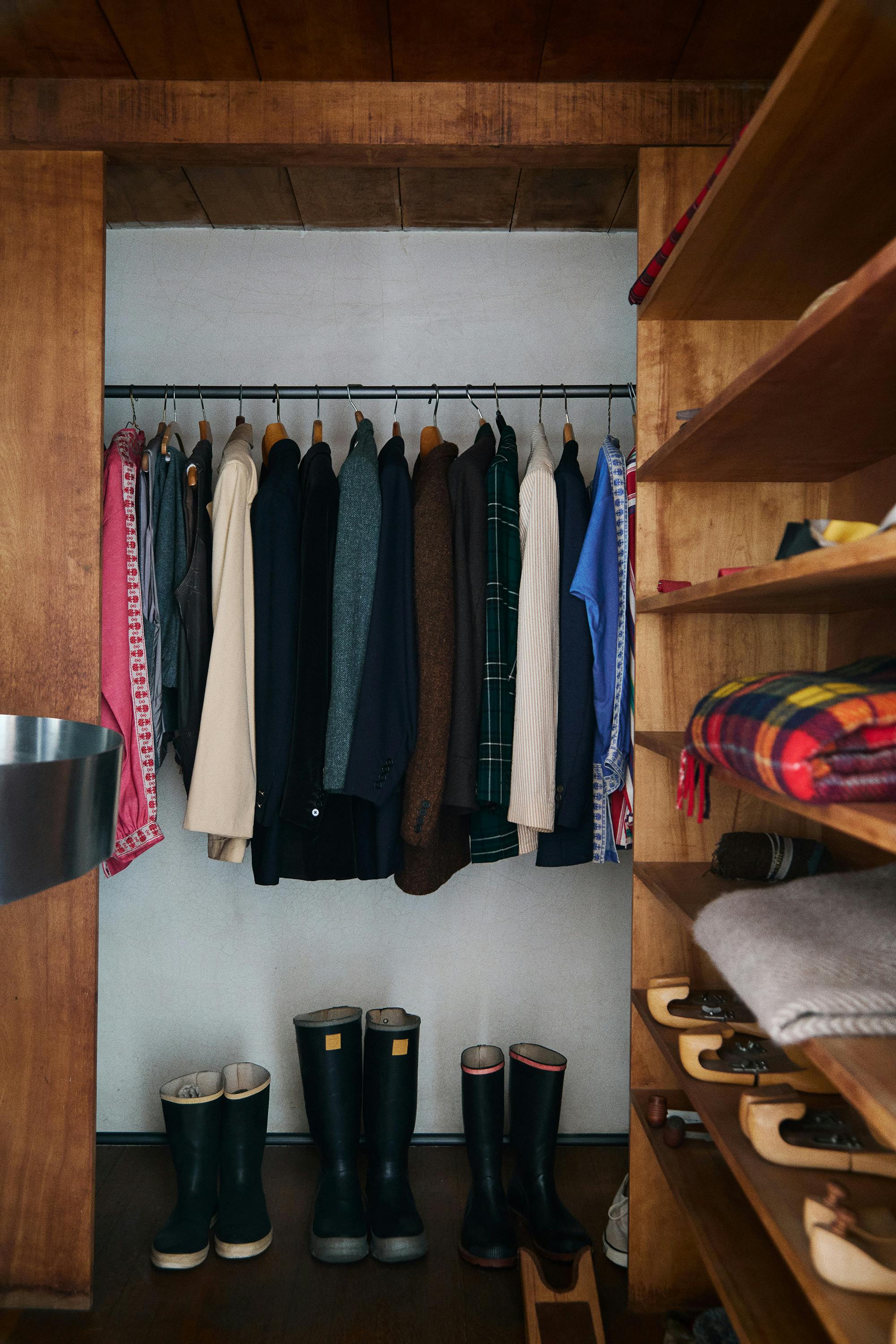
“Things were pretty well organized, and they had to be, because Don had three homes (in Texas, Switzerland, and New York in that order). You need rainboots in all three locations. Sometimes you buy them when you travel, and then you end up bringing them home. These are by Dunlop, Hood Bullseye, and a Swedish company called Tretorn, in that order.”
To Judd, “bad design was like a jackhammer you couldn’t shut off — it had to be isolated,” Flavin says. Standing in the Spring Street kitchen, nothing clamors. Nothing distracts.
Judd’s bed rests on a low platform surrounded by works from his friends and peers — John Chamberlain, Dan Flavin, and Claes Oldenburg — alongside one of Judd’s own pieces: a wall-mounted square painted in his signature cadmium red, bifurcated by a single asphalt tube. Judd wanted to make art that was straightforward and real — not symbolic, not pretending to be something else. Instead of creating compositions full of hidden meaning, he focused on items that simply exist in space, made from honest materials with clear proportions. This philosophy extends to his home. Judd was not interested in isolated things so much as in a complete system: art, design, and domestic life in deliberate alignment.
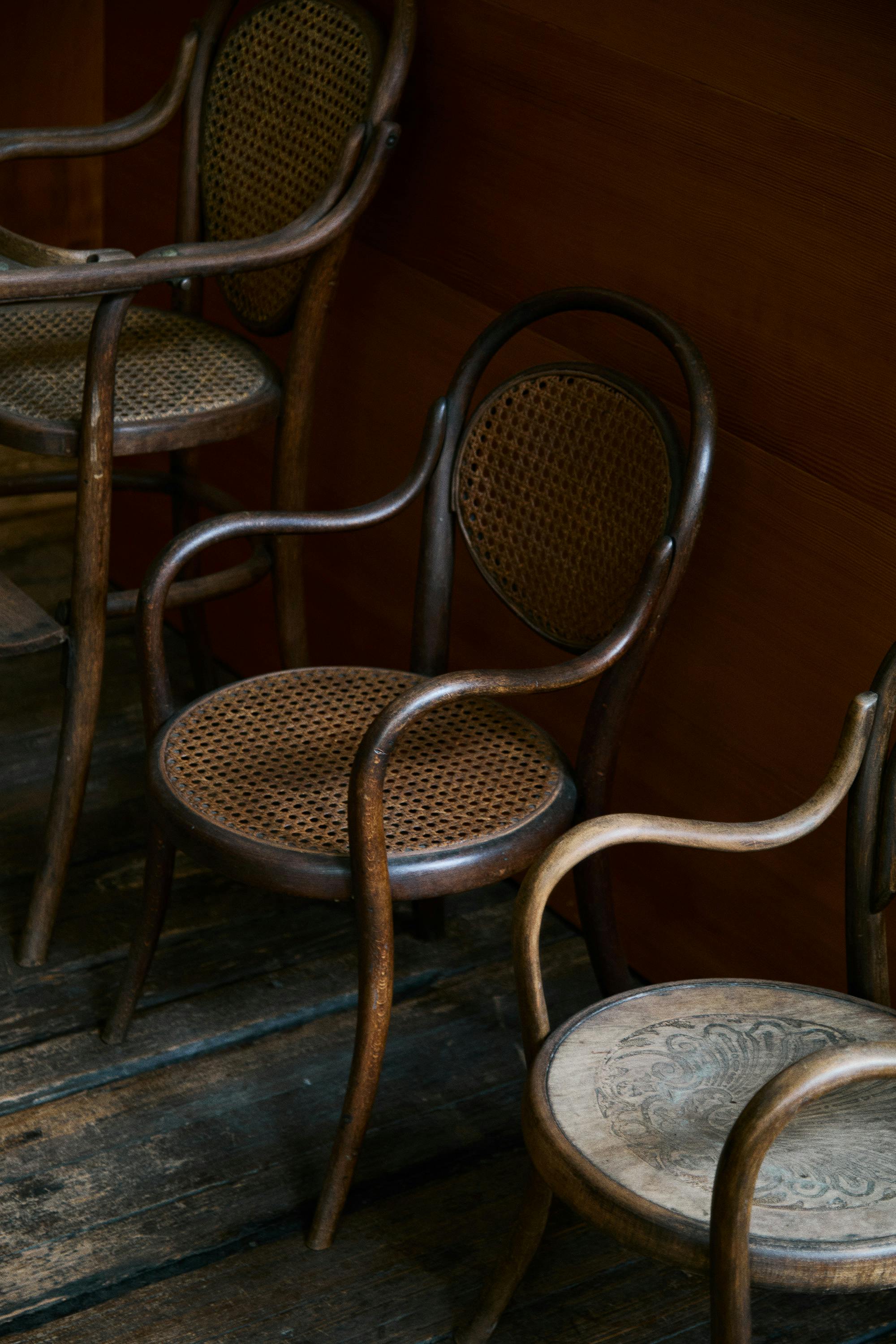
“These chairs are an example of what to do when given a design task: You need to buy chairs for your toddlers, but all the available options are made of garish plastic. What do you do? Get 19th century Thonet. [My sister] Rainer and I both used these, which is where the patina came from.”
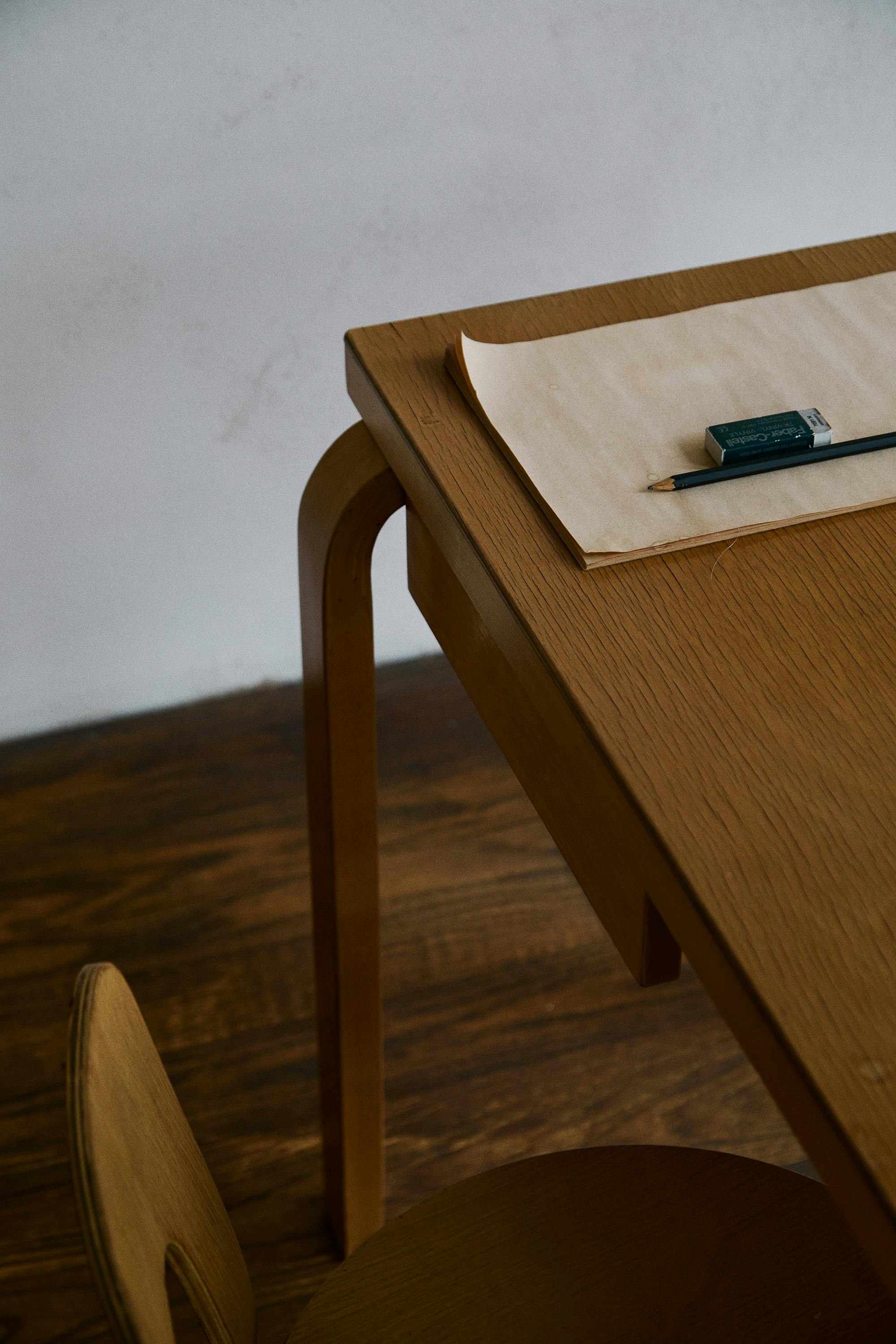
“The black pencil is from British manufacturer Derwent. Don wasn’t very particular about his writing tools, but as one would guess, they couldn’t look bad.”
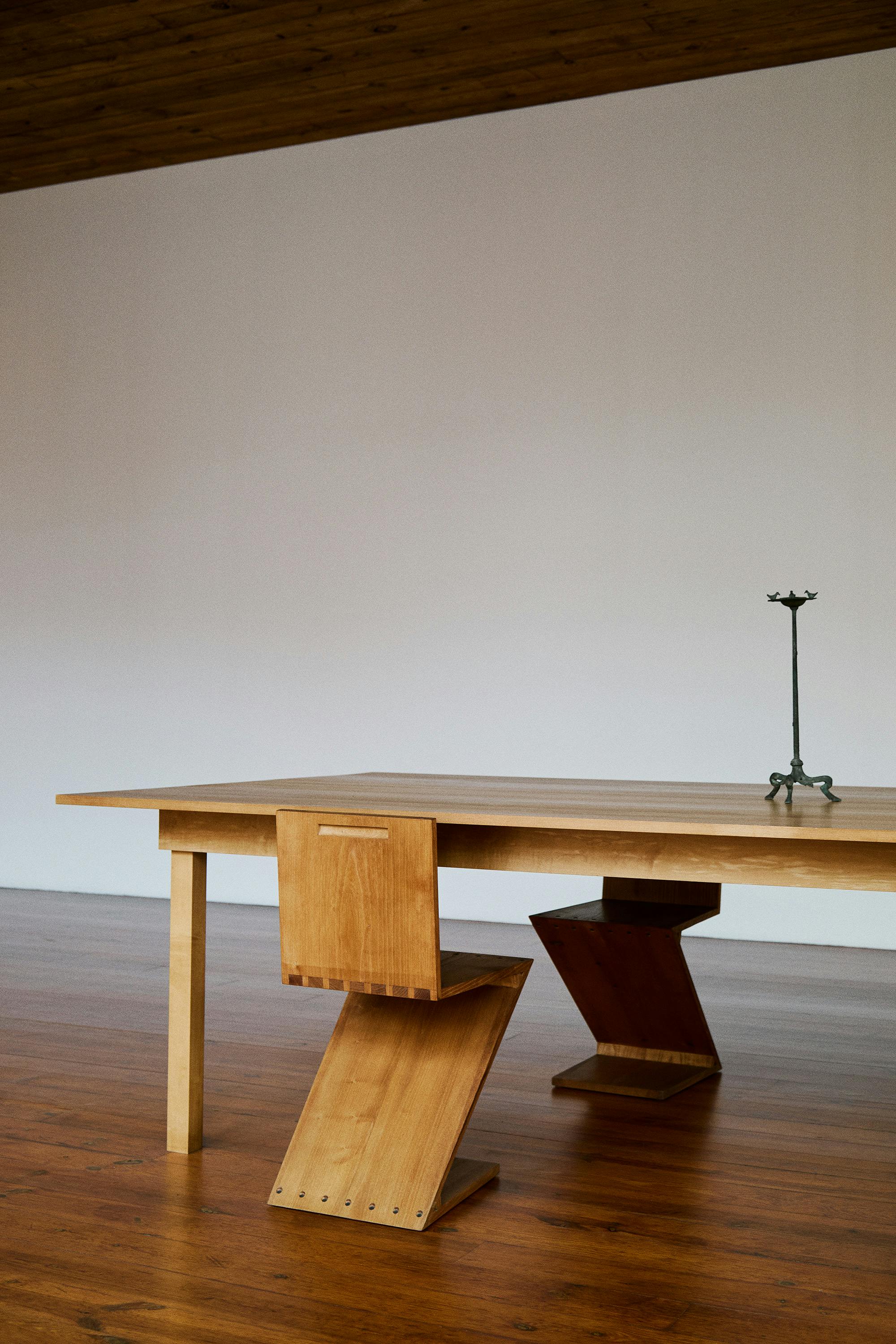
“These Zig-Zag Chairs are by Gerrit Rietveld, and the table was Don’s own, designed in 1981. I think his aesthetic was informed by his grandparents and the summers he spent on a farm in Missouri. They grew their own food and built their own houses and rarely bought stuff they didn’t need. Don hated capitalism, cities, ignorance, and waste.”
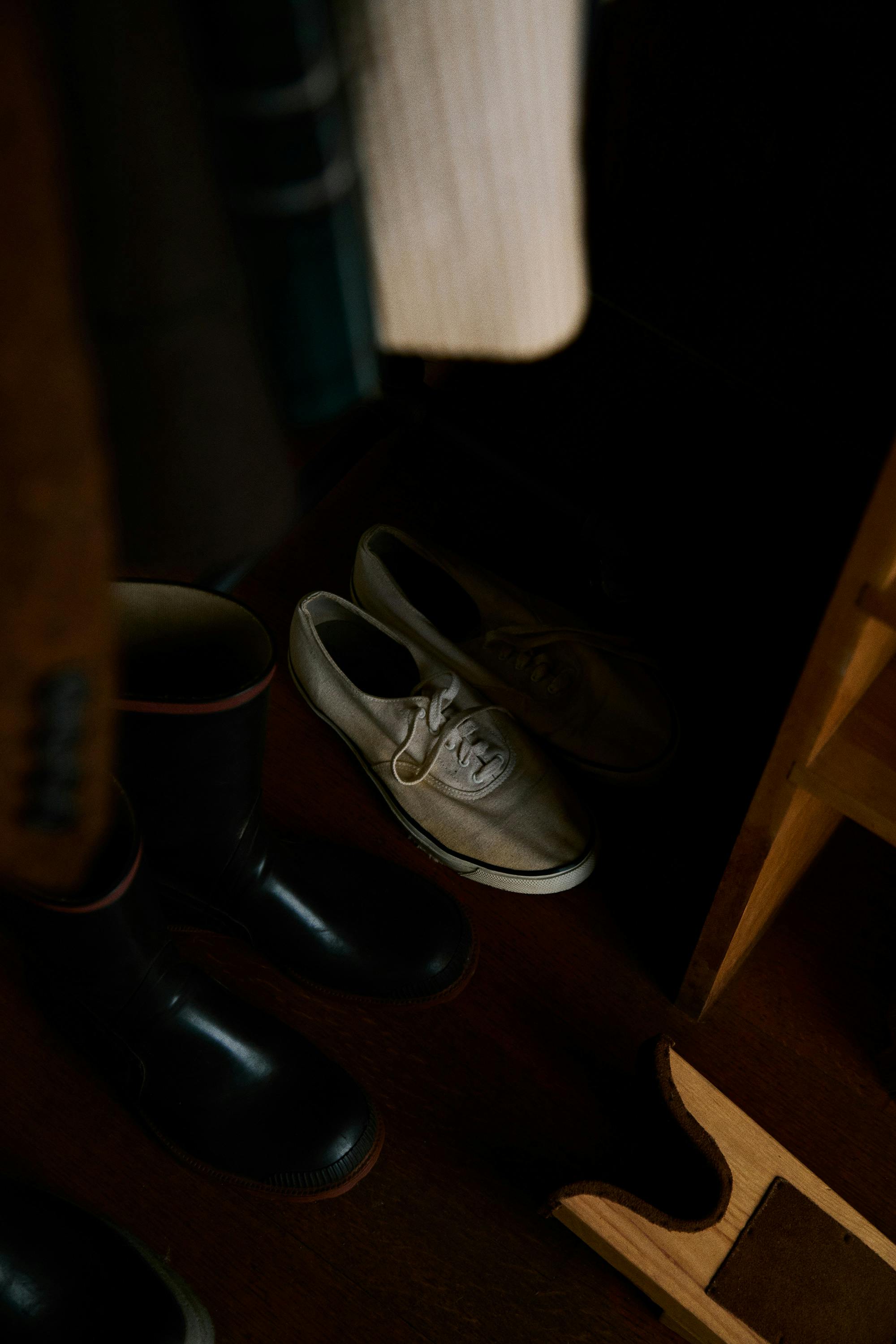
“These canvas Sperry Top-siders were probably bought to go on boats. Don never wore sneakers otherwise. He liked slip-on shoes: loafers and cowboy boots. He hated the Nikes I wore as a kid. They looked just like the garish milk cartons he had us remove from the dining room table because they were so ugly.”
Even mundane objects played a role. Spring Street features Shaker-inspired shelving, Italian splatterware ceramics, and Japanese tableware displayed alongside modernist designs by Alvar Aalto, Gerrit Rietveld, and Thonet. Judd’s own furniture — tables, chairs, daybeds — is severe and unornamented like his art, though he did not consider furniture art. “The art of a chair is not its resemblance to art, but is partly its reasonableness, usefulness, and scale as a chair,” he wrote in his essay “It’s Hard to Find a Good Lamp.”
Once something met Judd’s standards, it tended to remain, Flavin says. The one camera he ever purchased — a Hasselblad Super Wide, bought on the advice of the artist Larry Bell — was the only one he ever needed. “He thought things should be treated carefully and preserved,” Flavin says. His aesthetic was informed by his visual preference, but it also had an ethical core.
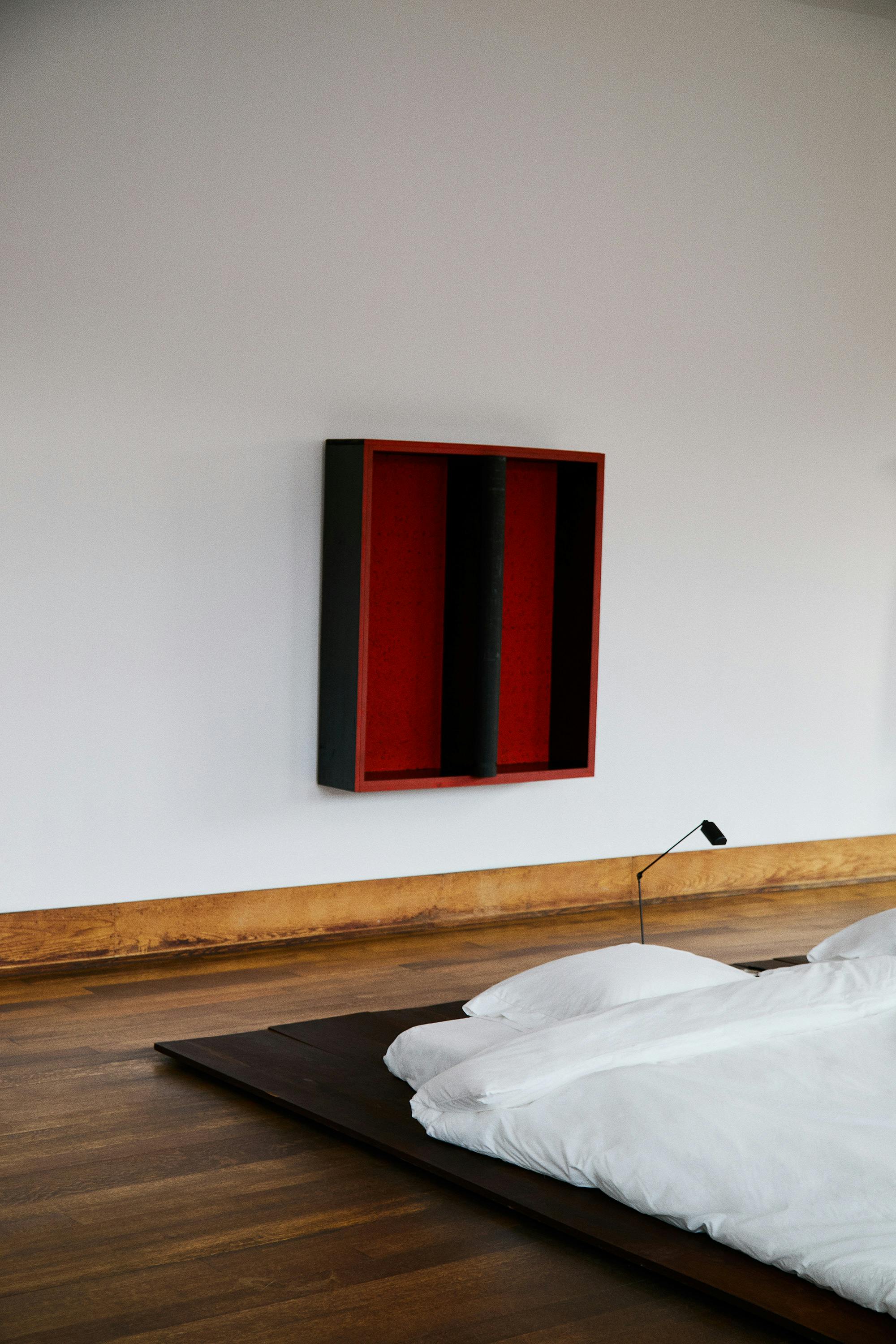
“Don would change things around until he felt he had the right work in the right place, and then it would stay there. Sometimes, the process took years. He hung one of his own pieces over the bed: untitled from 1962.” Donald Judd Art and Furniture © 2026 Judd Foundation / Artists Rights Society (ARS), New York
Interestingly, this vigilance did not extend to clothing. Flavin recalls that his father was “pretty indifferent” to what he wore. He bought jeans in Marfa because that was what was available; in Switzerland, he wore hunting clothes. He had green tartan jackets made because he liked the fabric. His exactingness was reserved for spaces and objects.
It is strange that this sensibility — rooted in thrift from Judd’s Depression-era childhood and the summers he spent on a farm in Missouri — has become one of the most widely imitated and commercially coveted aesthetics of our time. As art critic Jerry Saltz observed in New York Magazine: “Since the 1990s, endless streams of derivative decorators, designers, architects, less-is-more self-help gurus, Calvin Klein stores, landscape artists, furniture-makers, and corporate-office planners have owed many of their ideas to misunderstanding Judd’s notions of objects, space, material, and interior design, the built and lived-in environment.”
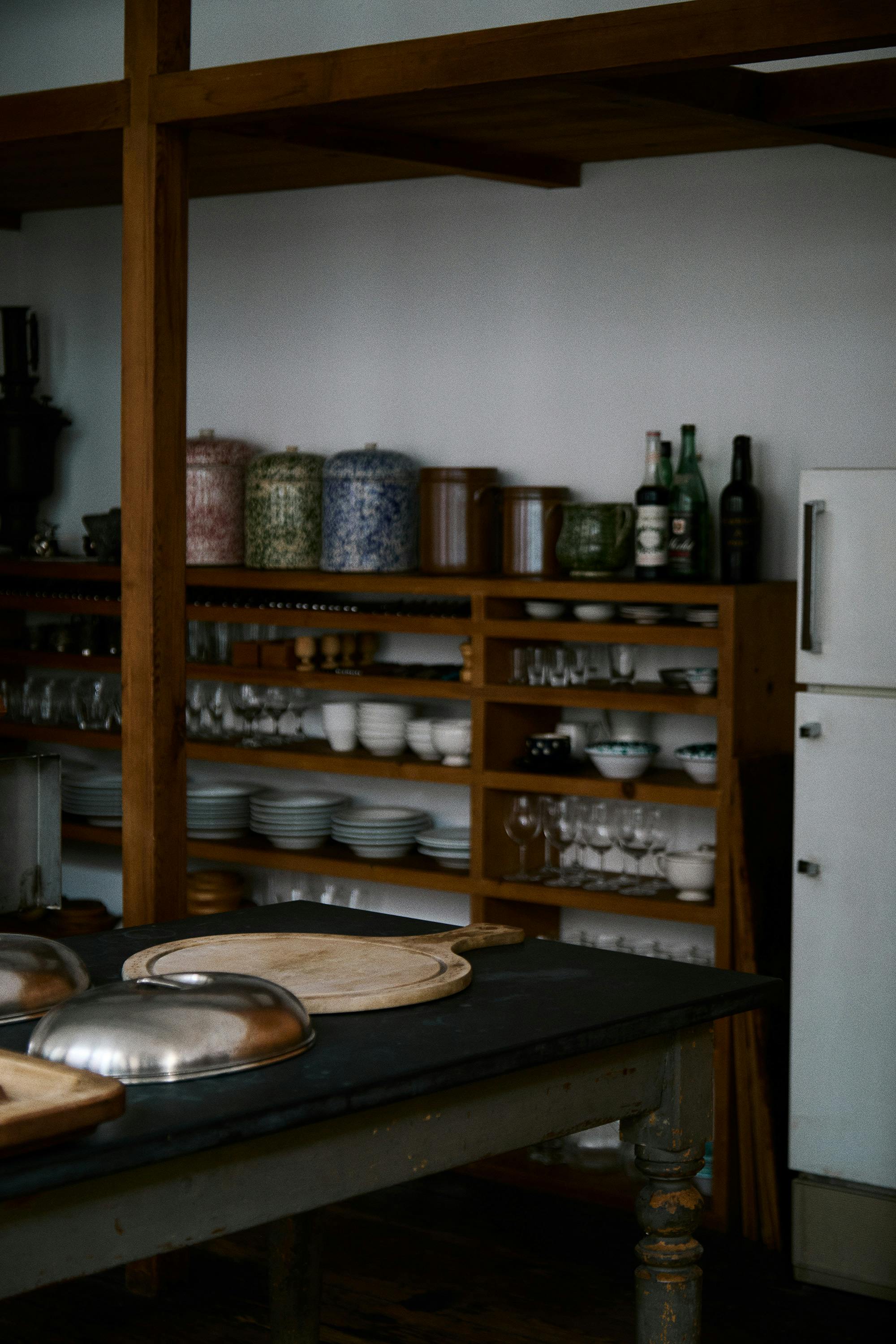
“Some things are well designed, and others are not. Life is too short to live around bad design. Don collected things he liked or admired because they were good, not because they “went together” in some sense. The samovar pictured here is from Russia, the molcajete is from Mexico, and the ceramic splatterware canisters are from Italy.”
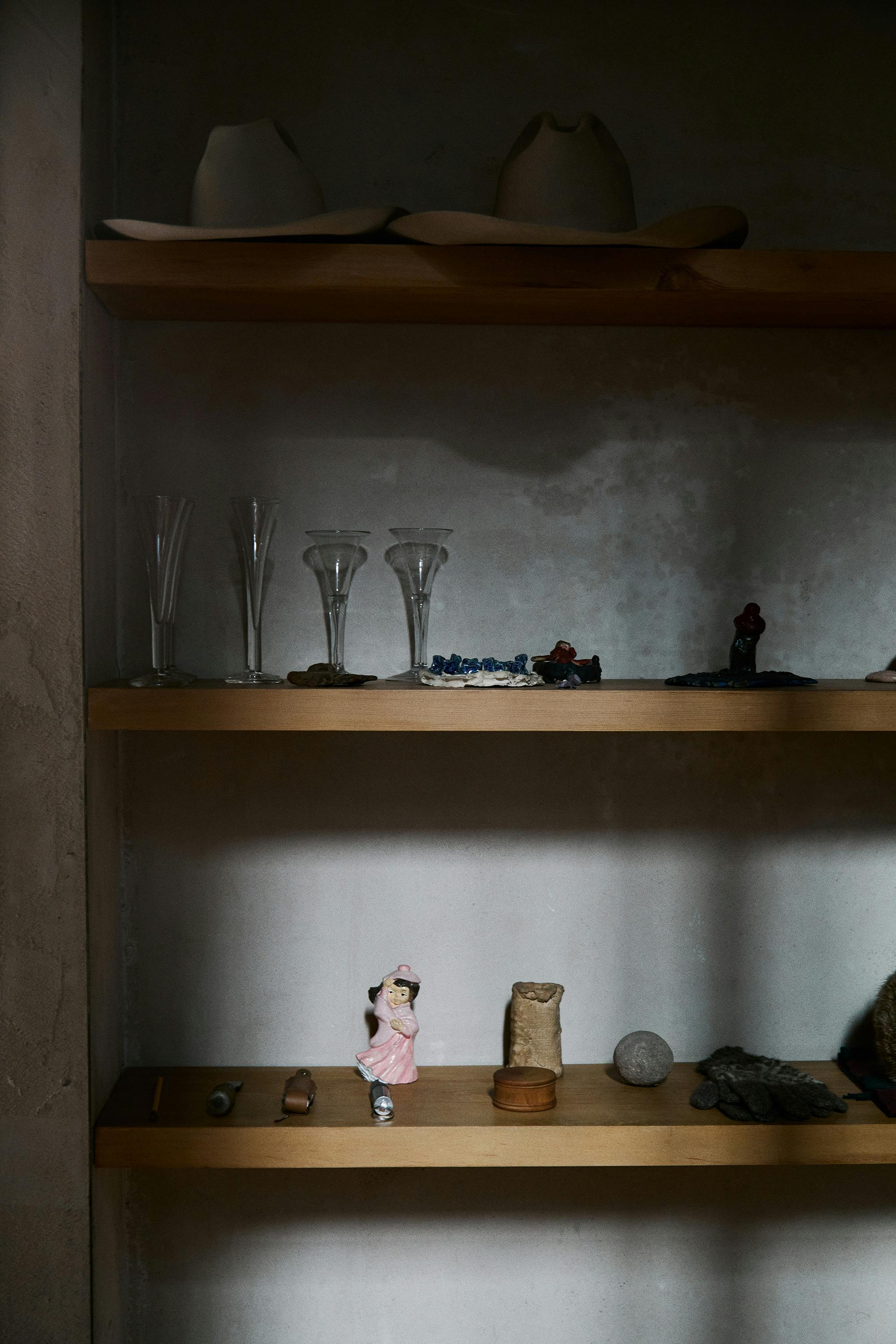
“101 Spring Street was slowly emptied of books as Don moved things to Texas. They were replaced by things like the ceramic objects Rainer and I made in school, or the mummified bat.”
This phenomenon reached its apex when Kim Kardashian commissioned a replica of Judd’s dining table. The ensuing legal spat with his foundation underscored how Judd has transcended from man to symbol. To say his name is to signal that one is “cultured” or “tasteful.” But in Judd’s universe, name-dropping holds no sway.
Flavin describes Judd’s New York home as “more still than when I lived there, but not much has changed.” (They did repair the heat, he noted, “which is a big improvement.”) It is emptier than it once was, especially toward the 1990s as Judd’s life shifted increasingly to Texas and Switzerland. Yet the integrity of Judd’s project remains.
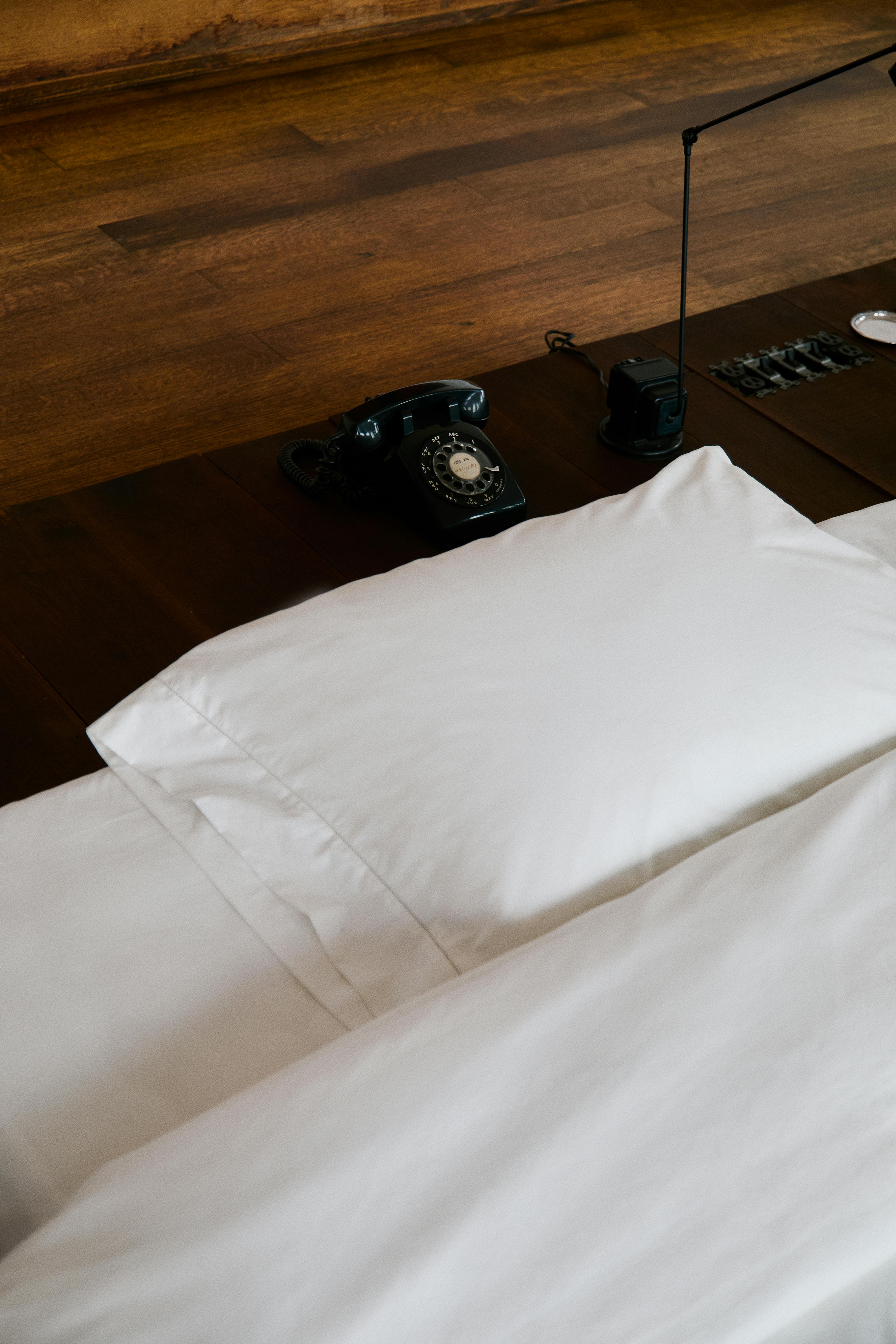
“Don hated talking on the phone, but you needed a phone in the 1970s so you could call the cops in case of emergencies. The placement is simply to keep it organized next to the lamp and the mattress, not littering up a corner of the room.”
Before his death, Judd established his foundation to preserve his work and the spaces that housed it. 101 Spring Street stands as a corrective to the decadence and theatrics of the art world — a place where the ideas and creations of one of the most important artists of the 20th century can be encountered as intended. To walk through the space is to be reminded that Judd was after something more demanding than a style. He sought a different relationship to the world of objects, and through them, to attention itself.
Anyone can book an appointment, climb the stairs, and step into that precise, sunlit space. Photographs aren’t allowed, and there are no gimmicks — just furniture built to last decades, transformative artworks, objects chosen with care, and floors softened by years of living. Judd’s legacy lands differently in person, not just an aesthetic to imitate, but as a reproach: rigorous, and still fully alive.
Credits
By: Hayley J. Clark
Captions by: Flavin Judd
Photographed by: Billal Taright
Donald Judd Art and Furniture: © 2026 Judd Foundation / Artists Rights Society (ARS), New York