Every Girl Wants to Dress Like Nhỏgirl
By Rolien Zonneveld
Photographed by Amy Pham Thi and Nozomi Miyoshi
Model: Jade Ommen
On a Saturday morning, a few hours before the first private shopping appointments begin, the vintage store Nhỏgirl has been turned into a photo studio. Tucked away along one of Amsterdam’s canals, the shop’s main room is stripped back to essentials: white walls, carefully arranged racks, and a table stacked with indie magazines. Overhead, a skylight lets in a wash of natural light that has come to define the Nhỏgirl aesthetic as much as the clothes themselves.
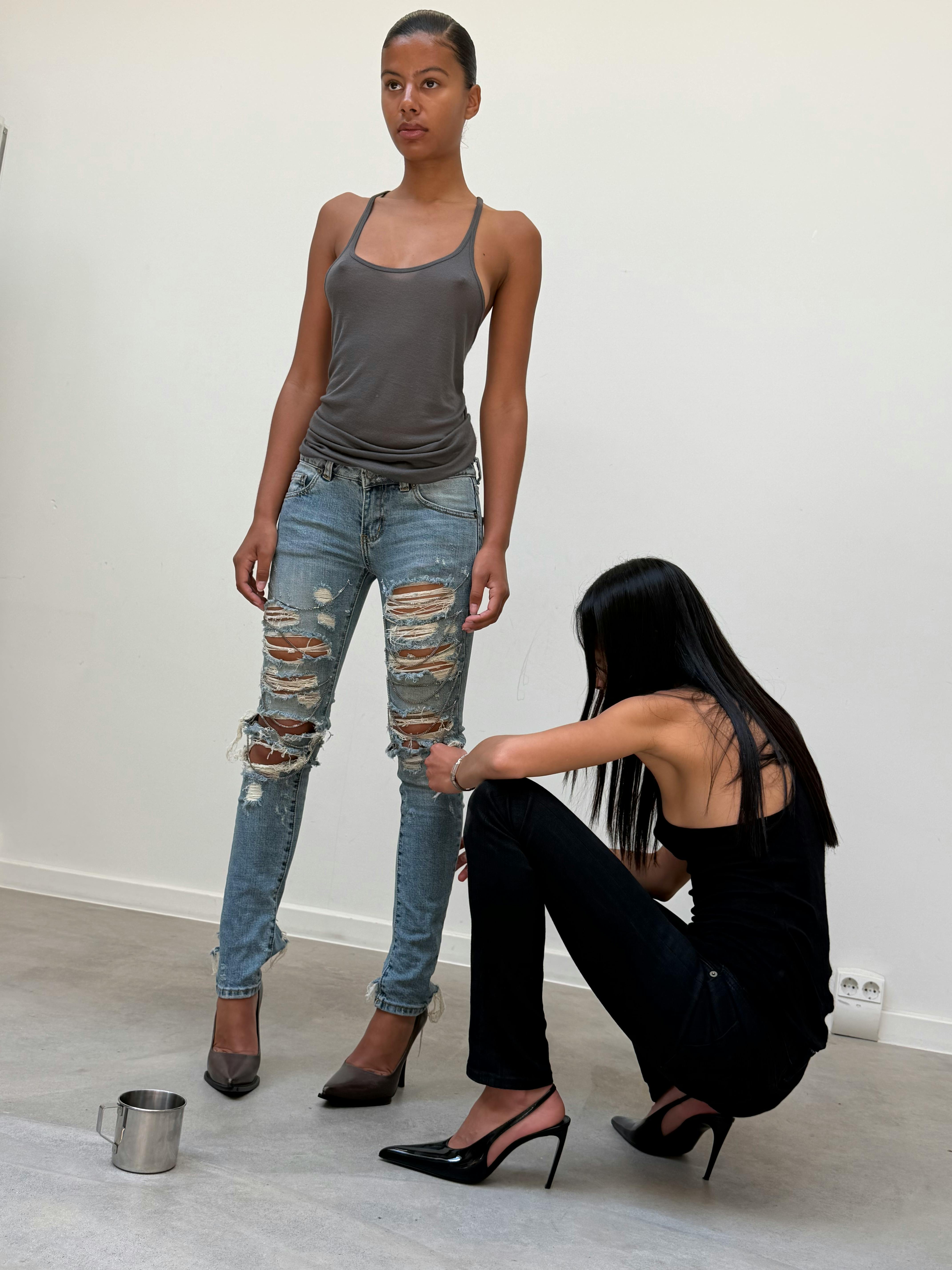
Jade Ommen takes her place beneath it. She’s been one of the store’s recurring models since Nhỏgirl founder Amy Pham Thi approached her two years ago. Her hair is slicked into a bun, and she wears no visible makeup. She’s in a cashmere Prada top paired with timeworn trousers, their faded fabric and softened edges carrying the marks of previous wear.
Ommen shifts her weight, slips her hands into her pockets, and lets her gaze drift to the camera.
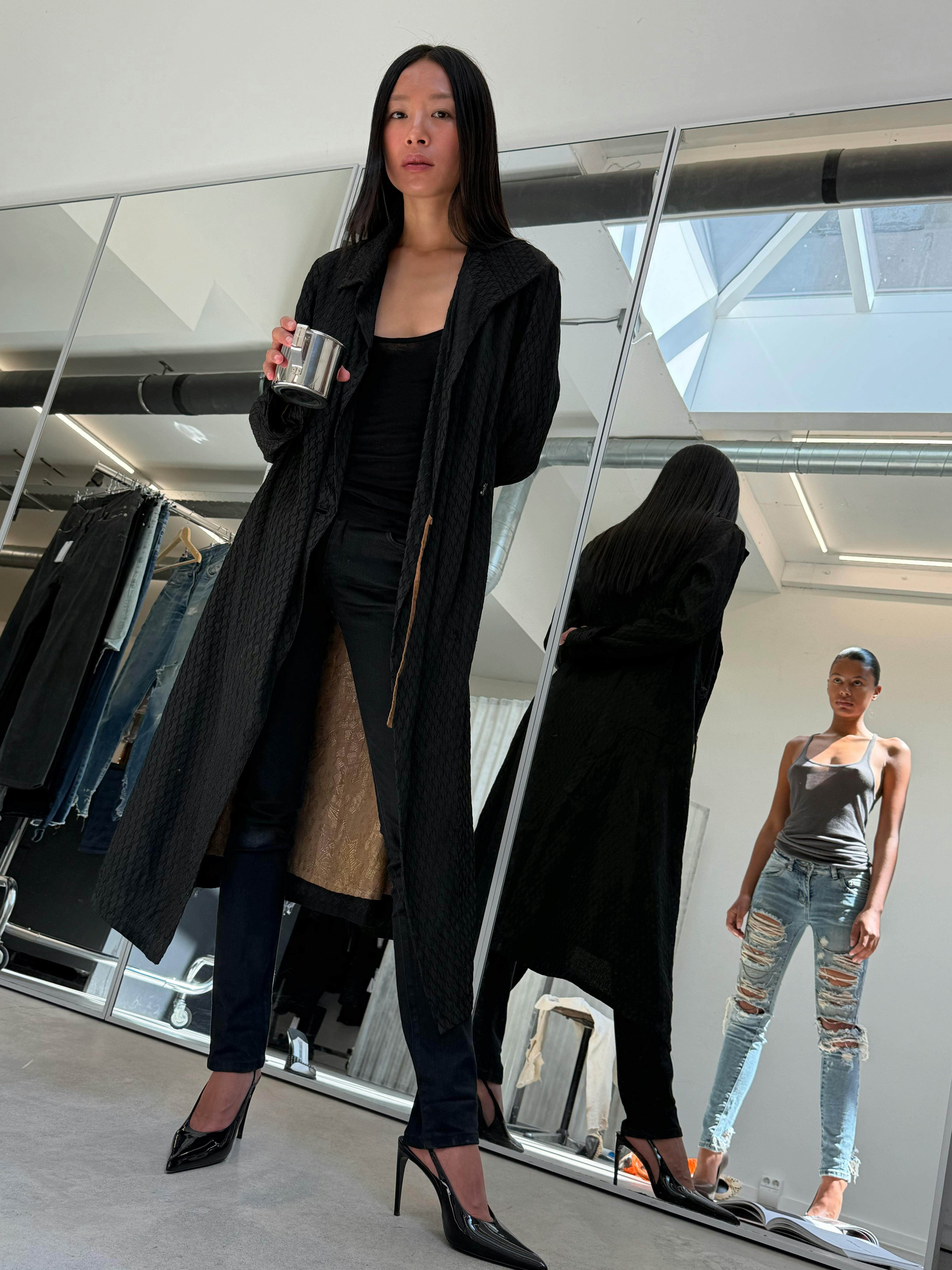
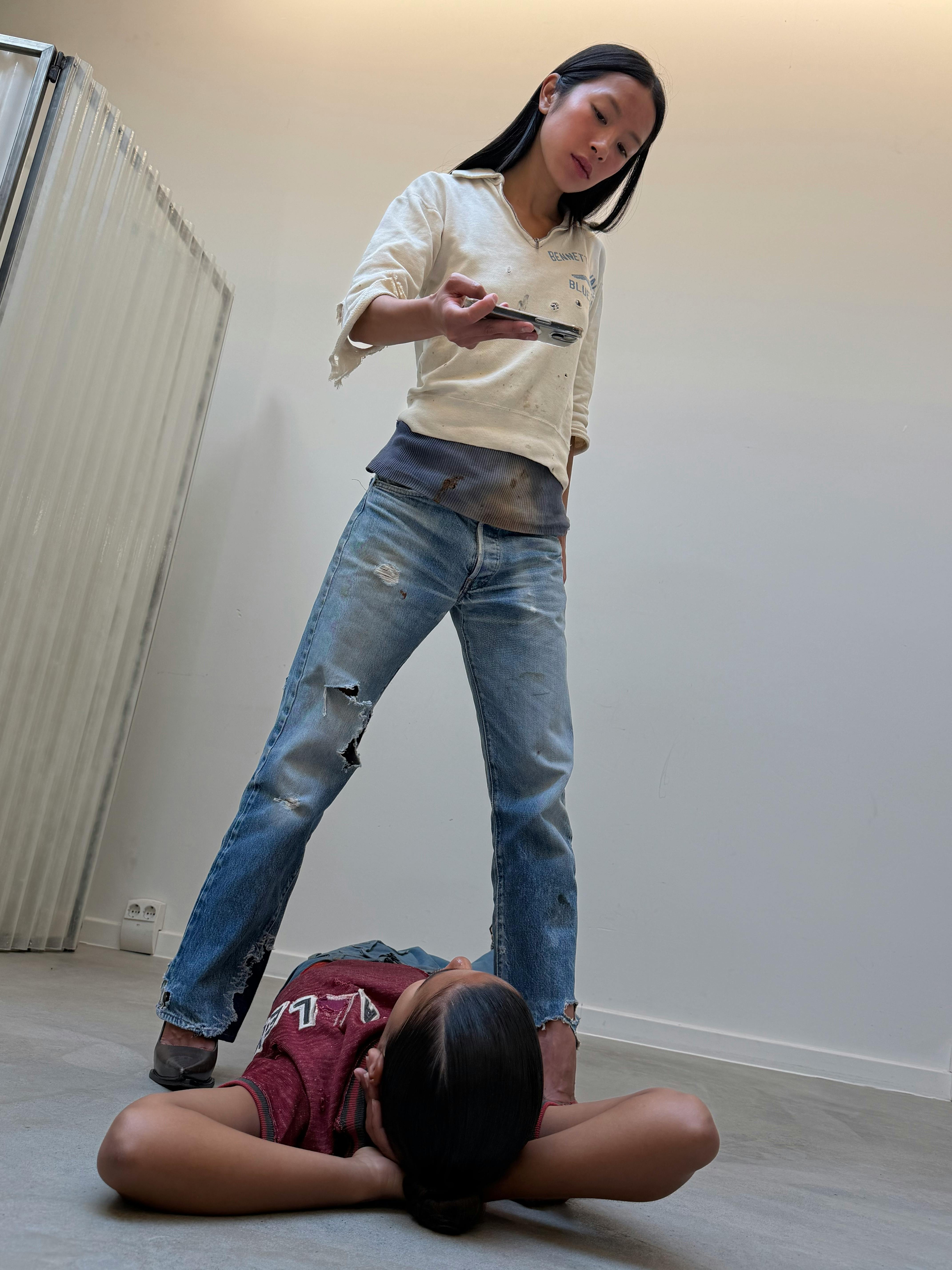
In this case, the camera is an iPhone. And the photographer is Pham Thi herself. Wearing no makeup, loose jeans, and an athletic sweatshirt so worn it looks like crêpe, she could just as easily be the one in front of the lens.
Scroll through the Instagram pages of vintage stores in New York City, Copenhagen, Seoul, or Melbourne, and a pattern starts to emerge: a stripped-back interior, a white or beige wall, the bare, glowy face of a model. There’s often a poured concrete floor, and monochrome vintage and designer pieces hang from the girl just so. The light is natural, the camera setup simple, if there’s one at all. “Once you’ve seen that visual language enough times,” says Dakota Butler, a New York City–based creative consultant and Nhỏgirl customer, “you start recognizing it everywhere.”
“Once you’ve seen that visual language enough times, you start recognizing it everywhere.”
Dakota Butler, Nhỏgirl customer
Many of these stores might not have consciously borrowed from Nhỏgirl. After all, the most pervasive aesthetics spread slowly, then suddenly seem to be everywhere at once. Nhỏgirl might not have been first — or it may have been. It certainly got there early. Levi’s Engineered jeans are now commonly referred to as “Nhỏgirl jeans,” while TikTok users routinely describe outfits — consisting of oversized sweaters, or vintage henleys and mini skirts — as “Nhỏgirl coded.” One vintage shop in an unassuming city is now a global reference point for cool-girl style.

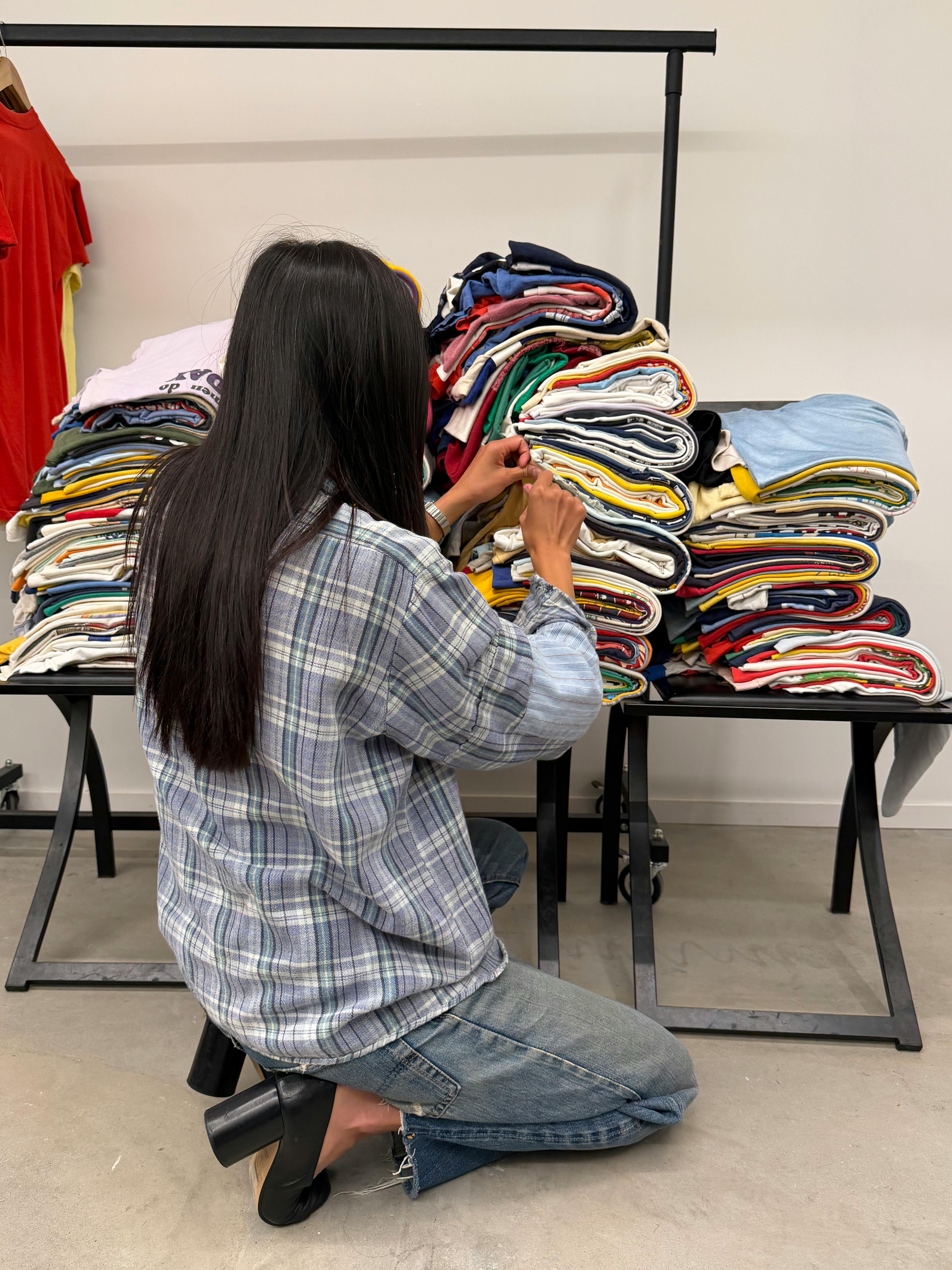
Within hours, one of Pham Thi’s images will appear on Nhỏgirl’s Instagram page. Although her business consists of a single appointment-only showroom in Amsterdam, the account has amassed more than 100,000 followers. Nhỏgirl’s posts are saved, reposted, and endlessly referenced — not only for the items on sale, but for the specific way the clothes are worn, combined, and framed.
By the time many visitors step through the door of the store, they’ve been living in the Nhỏgirl world for months, sometimes years. They are no longer searching for one particular jacket or pair of trousers. They’re looking for a sensibility they already know by heart. “Calling it simply a vintage store doesn’t really give it enough credit,” Butler adds. “It’s a place where you can imagine another way of dressing.”
Pham Thi did not come to fashion through retail. Born and raised in Berlin to Vietnamese parents, she trained as a dressmaker before moving into communication design, interested less in the garments themselves than in the ways images shape our understanding of them. “I was sewing, and I thought: I can’t even do a straight line,” she says, laughing. “There are people who are incredibly talented at that, and I realized I’m not one of them.”
What attracted her instead was everything around the garment: the photography, the branding, the art direction. In short, the image-making. Which is why Nhỏgirl has never quite behaved like a store.
When Pham Thi started Nhỏgirl in 2019, she wasn’t simply selling vintage but constructing a visual world. Her partner had already built a successful menswear business, rooted in the visual codes that dominated the time: loud graphics, streetwear, and logos. After moving to Amsterdam, Pham Thi joined him, initially helping with photography and styling. But she found herself gravitating toward softer silhouettes and a more minimal visual language. The solution was not to reinvent the existing business but to create a second one. Pham Thi launched Nhỏgirl as a parallel project, giving shape to the aesthetic she had been trying to introduce all along.
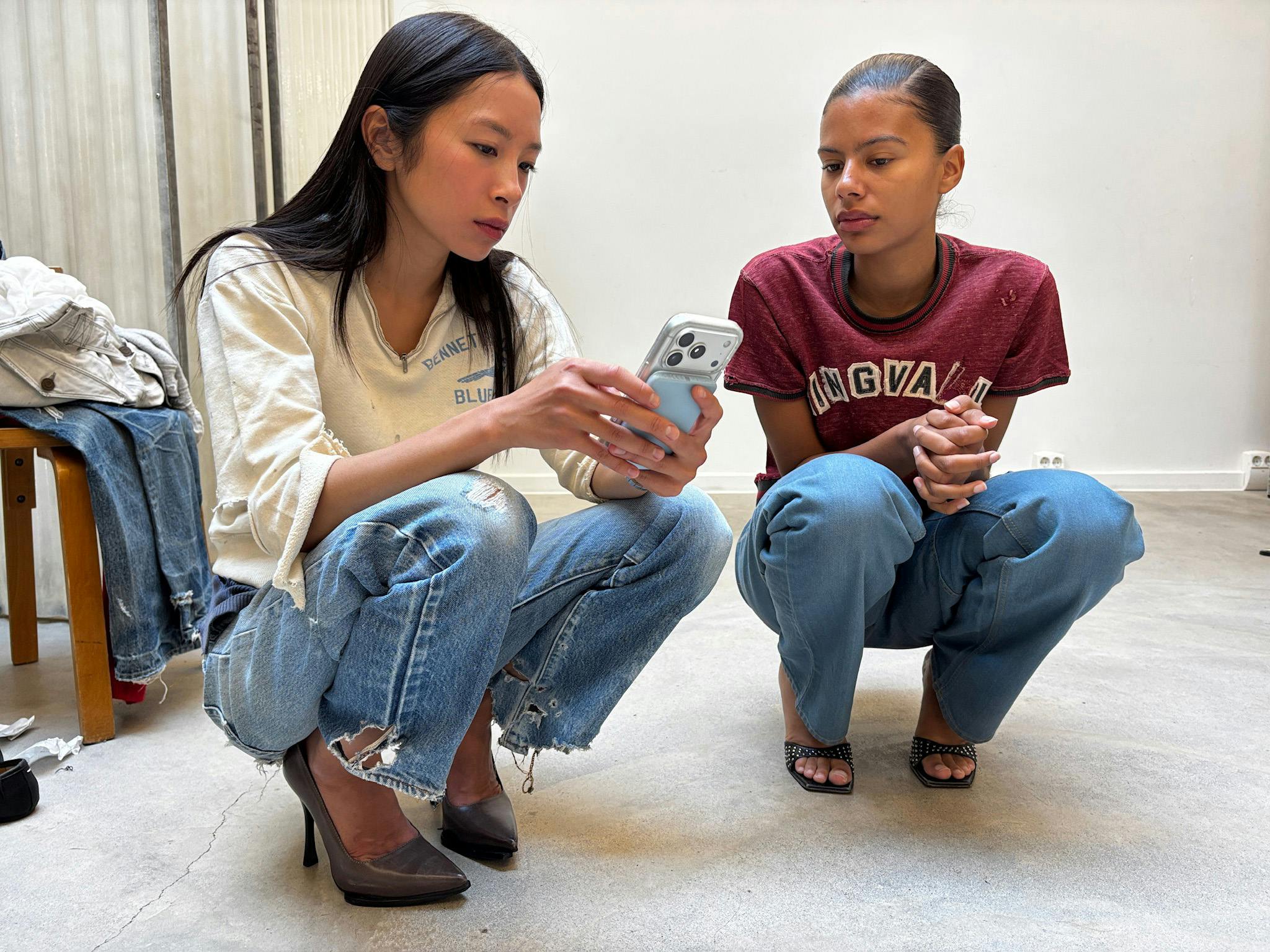
In the beginning, the two ran both ventures side by side, surrounded by piles of clothing in a house that increasingly resembled a stockroom. “It was us, a simple white backdrop, and some cheap lights,” Pham Thi recalls. She describes those early creative decisions as instinctive rather than strategic.
By now, she has refined the formula. Pham Thi avoids heavy makeup, obvious tattoos, or striking piercings on her models, removing anything that might compete with the garments themselves. Instead of minimalism, she speaks about tension. “I always like a bit of unease,” she says. “I’m drawn to things that clash.” A cashmere knit might be paired with a patched-up school jacket, or military surplus softened by sheer fabrics.
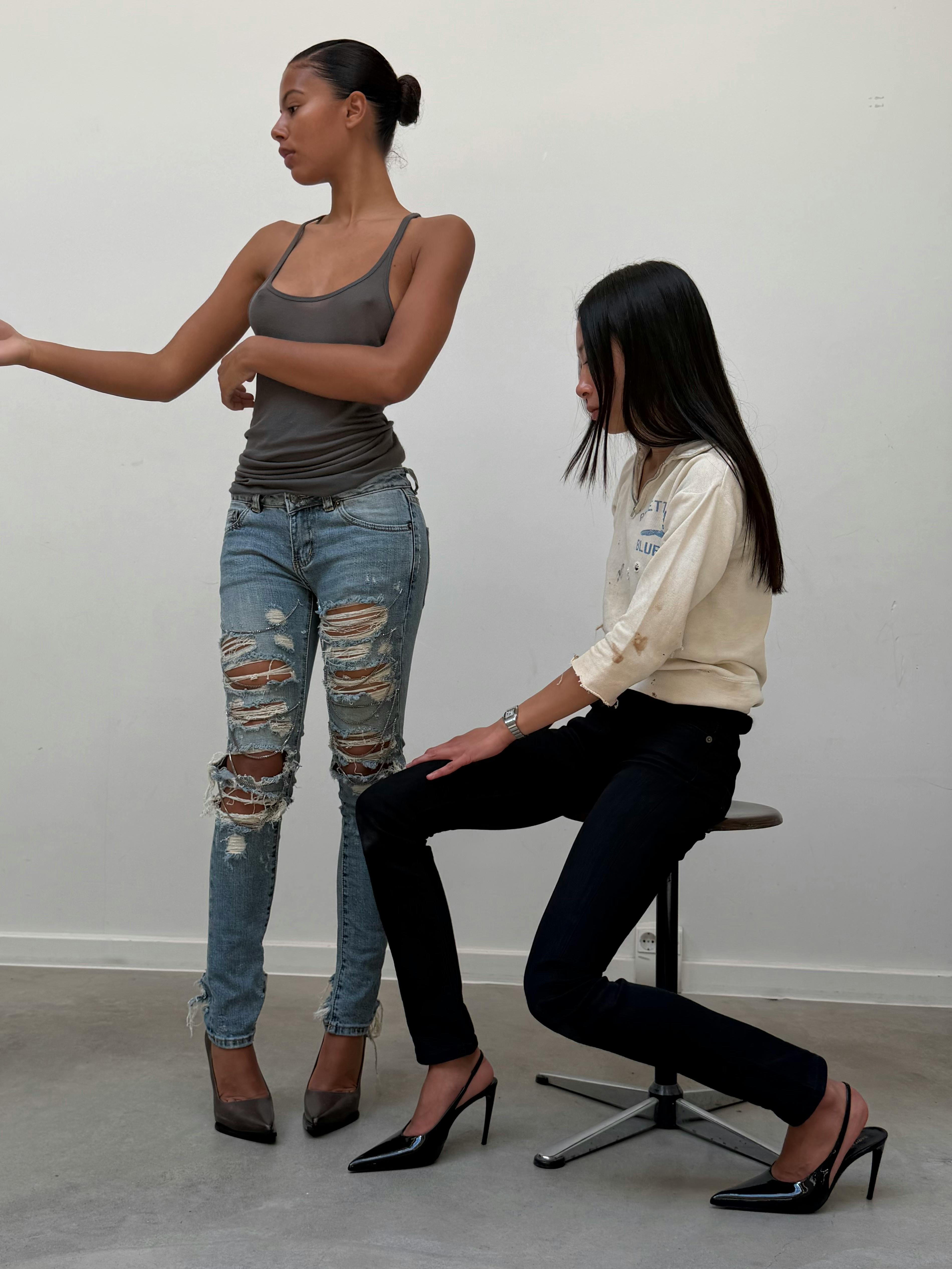
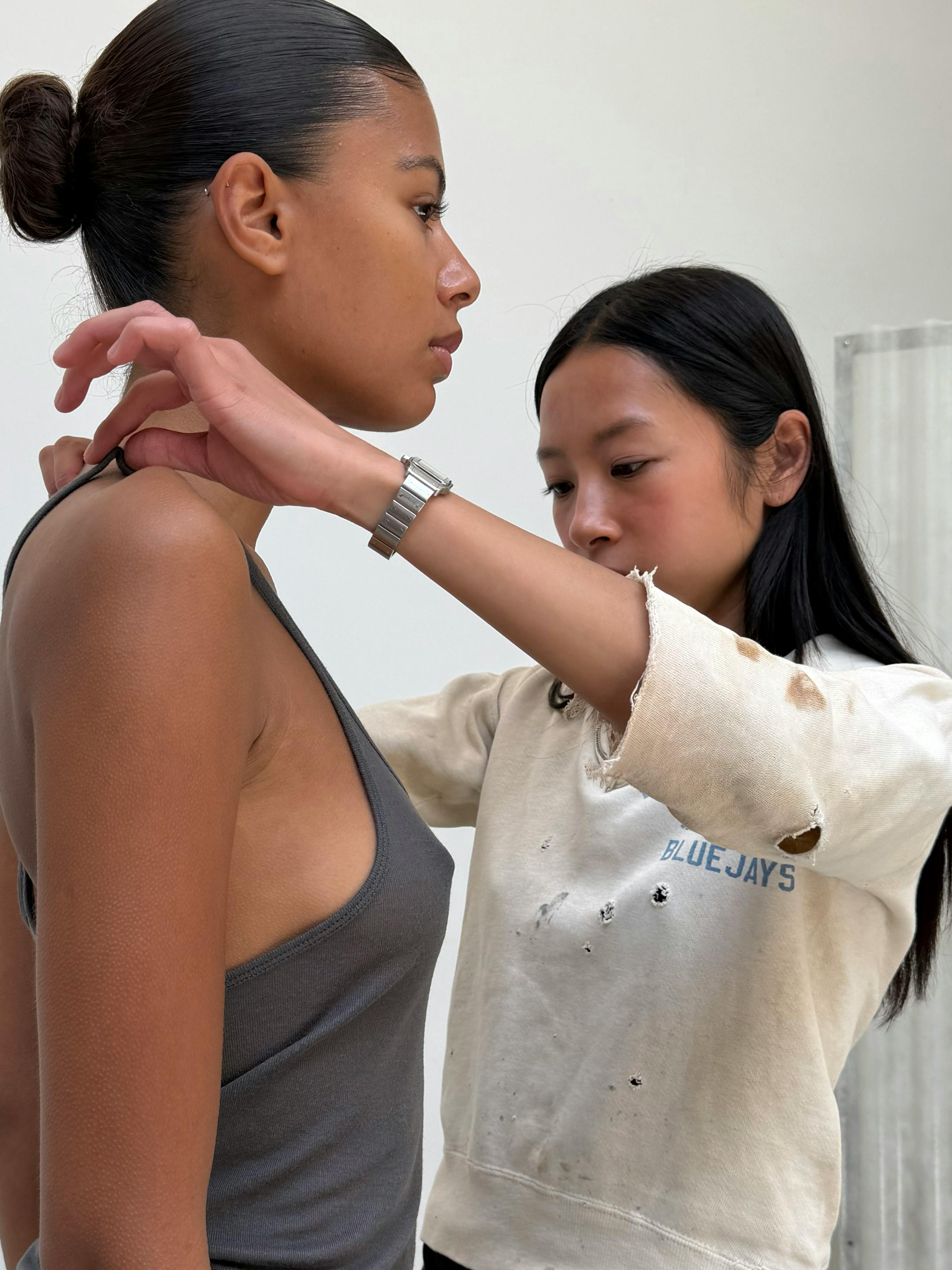
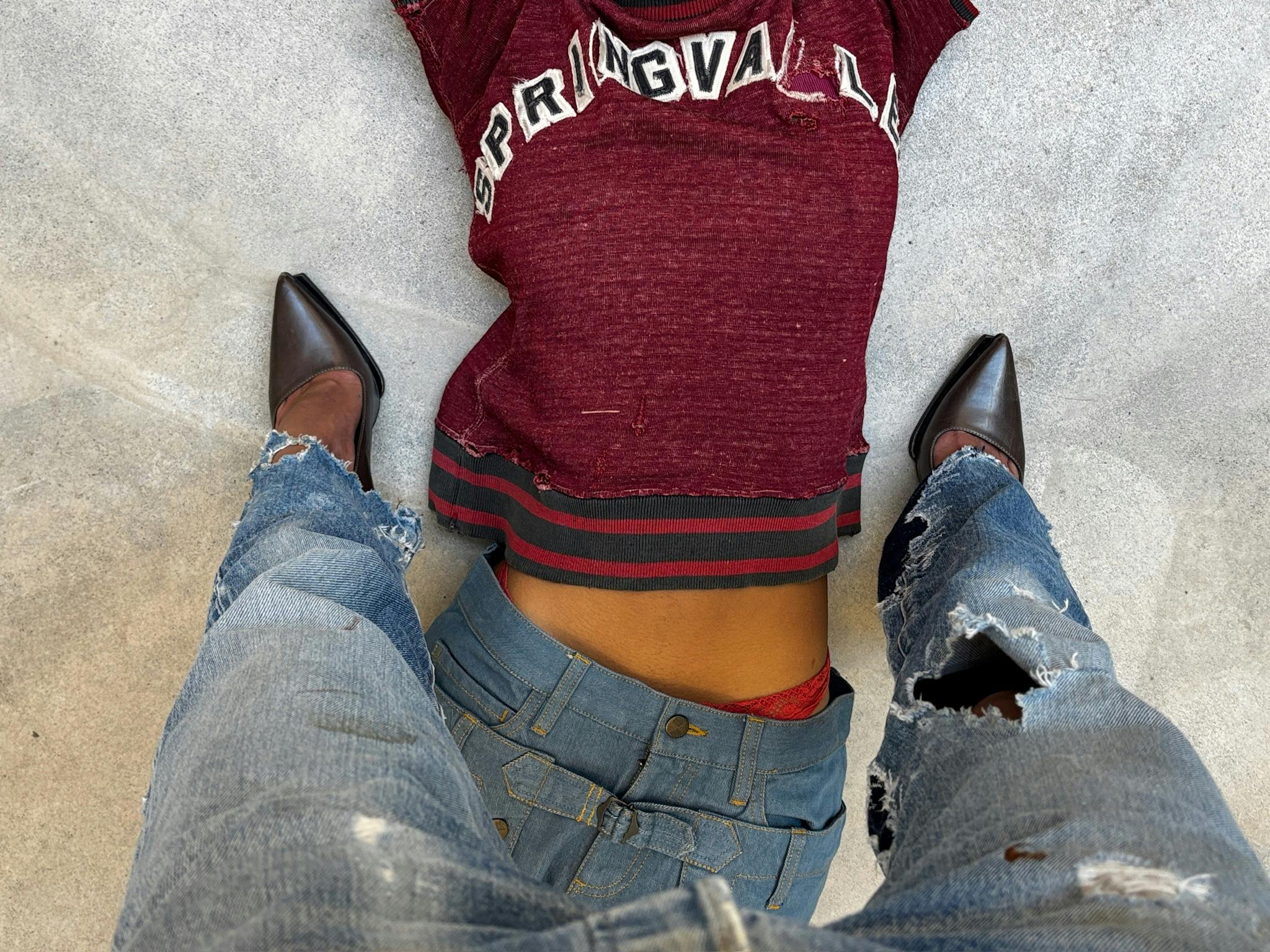
Nothing is clipped or pinned to create the illusion of a perfect fit. A jacket may sit slightly oversized; a pair of trousers might hang lower than expected, revealing the waistband of a pair of underwear beneath. “I don’t mind that at all,” Pham Thi says. “I want the garment to fall the way it naturally falls on a body. If a thong is showing, that’s fine. I’m not trying to force clothes into an ideal shape.” The women she photographs are often braless beneath a sheer knit or lightweight top. Pham Thi sees a certain freedom in that kind of styling. “I like to show things as they are,” she says.
“I want the garment to fall the way it naturally falls on a body. If a thong is showing, that’s fine.”
Amy Pham Thi
From the outset, Nhỏgirl attracted an unexpectedly international audience. Pieces were auctioned through Instagram posts, with bidding wars unfolding in the comments and buyers setting alarms for the final hour. On any given day, one parcel might be shipped to New York, while another would be collected in-person. What formed around the online platform was less a customer base than a community that returned day after day to see what Pham Thi would put together next.
Pham Thi’s overstuffed house eventually gave way to a spacious showroom. Long rails stretch along the walls, densely packed with hundreds of carefully selected garments. “Everything felt intentional,” recalls Butler, the creative consultant, of her first visit. “Nothing was there just to fill space.”
Although the business has grown far beyond its early days, Pham Thi still photographs new arrivals and answers customer DMs. She has deliberately resisted the kind of high-production machinery that many successful vintage stores embrace, preferring to keep the process scaled-down enough that she can stay involved.
Before appointments begin, she moves through the showroom, straightening a sleeve, adjusting the spacing between hangers. Staff are already on the floor, but she rarely leaves these last details to anyone else. “I can’t help it,” she says. Nothing enters the frame without passing her eye first.
The same instinct shapes the pieces Pham Thi selects. She gravitates toward garments that carry visible traces of another life: faded knees, repaired jackets, paper-thin T-shirts softened by decades of wear. Holding up what she identifies as a patched Chinese school uniform, she shrugs. “You can copy the shape or the color,” she says, “but you can’t reproduce the history. The repairs, the wear, the little imperfections — those happened because somebody actually lived in it.”
“At heart, we’re just a vintage store. But people seem to experience us like a brand.”
Amy Pham Thi
Yet the appeal of Nhỏgirl extends well beyond vintage itself. The garments become raw material for something larger: a version of femininity that resonates with young people across the world. There’s a softness to the clothing, but also a utility. The models who wear it are beautiful, simple, honest, but also bold and wholly unconcerned. It’s a cool factor that can’t be pinned down but that endless fans have tried to replicate. “At heart, we’re just a vintage store,” Pham Thi says with a laugh. “But people seem to experience us like a brand.”
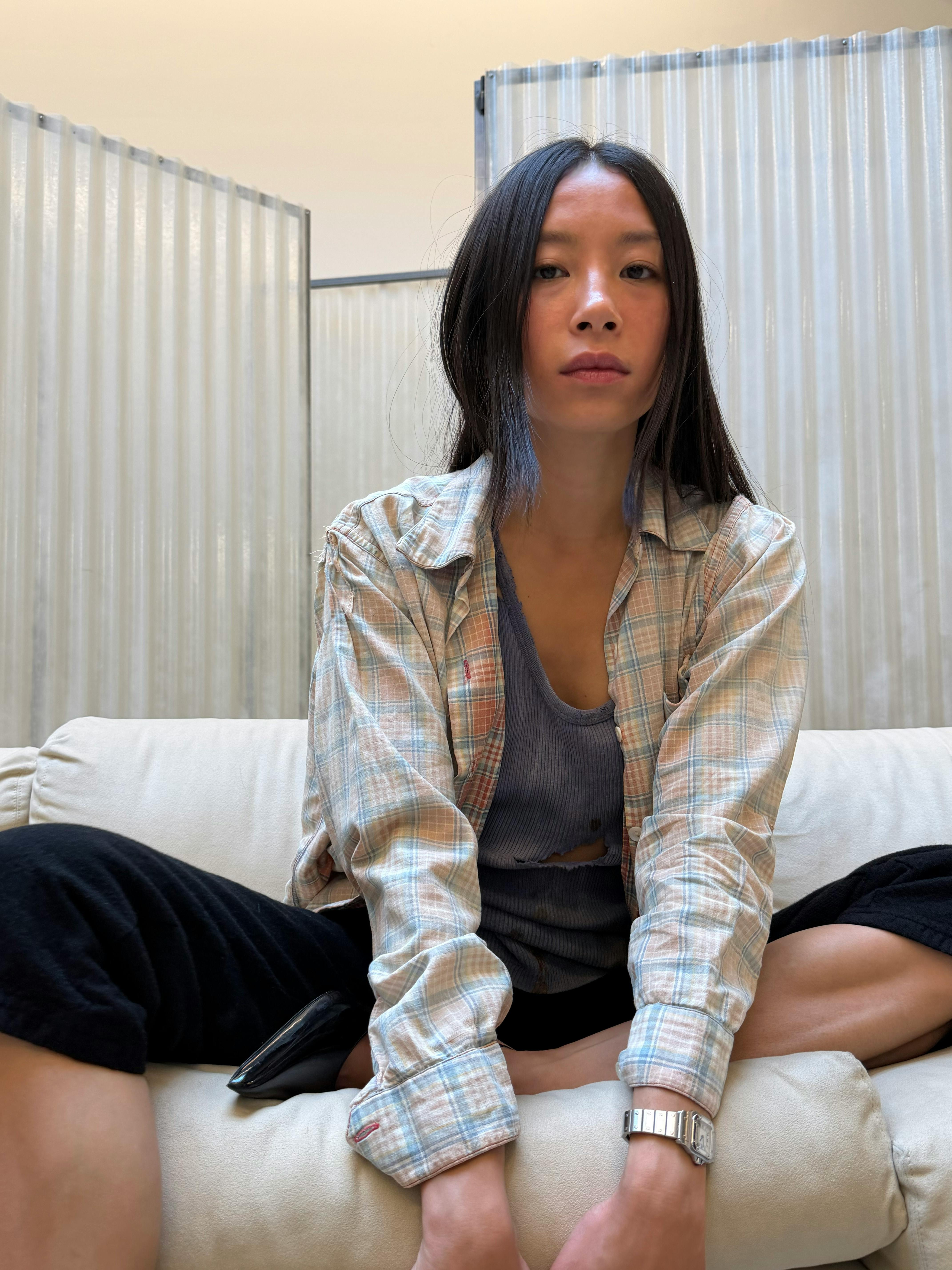
“The images never tell you, ‘This is the only way to wear something,’” Butler adds. “They show you a possibility.”
Some customers arrive in Amsterdam with an empty suitcase, Pham Thi says. Others build a visit to the showroom into their European itinerary. Butler added Amsterdam to her list of stops on a monthlong Europe trip largely because of Nhỏgirl. “The shop was number one on my list,” she says.
Pham Thi is hesitant to define her customer base too narrowly. Trends change, she says, and uniforms quickly become boring. What she recognizes instead is a certain confidence: people who trust their eye and are comfortable with a little friction. “I like people who are a little bit fearless,” she says, “who don’t need everything to be perfect.”
Credits
By: Rolien Zonneveld
Photographed by: Amy Pham Thi and Nozomi Miyoshi
Model: Jade Ommen