“What you do when you’re 10 is what you should be doing when you’re grown up,” Jesper Kouthoofd says a few minutes into our conversation. He makes it sound self-evident, but it says a lot about teenage engineering, the Stockholm-based electronics and design company he founded in 2005.
Over two decades, teenage engineering has built a worldwide following among musicians and producers, from aspiring hobbyists to A-listers such as Travis Scott, Sabrina Carpenter, and Kevin Parker. Its almost magical appeal lies less in products, marketing, or strategy than in Kouthoofd’s attempt to scale the fascinations of his childhood self into a sizable business.
Over two decades, teenage engineering has built a worldwide following among musicians and producers, from aspiring hobbyists to A-listers such as Travis Scott, Sabrina Carpenter, and Kevin Parker. Its almost magical appeal lies less in products, marketing, or strategy than in Kouthoofd’s attempt to scale the fascinations of his childhood self into a sizable business.
JESPER KOUTHOOFD, teenage engineering founder
As romantic as that may sound, it has very real consequences, including decisions few CEOs would seriously consider. Just how far Kouthoofd is willing to take his philosophy becomes clear when Kouthoofd tells me that, as part of a reorganization last fall, he announced to his team he is planning to stop making synthesizers altogether. The OP-1 is no exception. Launched in 2011, it put teenage engineering on the map and has been central to its success ever since.
As romantic as that may sound, it has very real consequences, including decisions few CEOs would seriously consider. Just how far Kouthoofd is willing to take his philosophy becomes clear when Kouthoofd tells me that, as part of a reorganization last fall, he announced to his team he is planning to stop making synthesizers altogether. The OP-1 is no exception. Launched in 2011, it put teenage engineering on the map and has been central to its success ever since.
“Everyone was like, ‘What are you talking about?’ But I’ve come to the conclusion that, for us, the products aren’t the business,” Kouthoofd says. “We can be so much more than that.”
It’s this kind of thinking that has made teenage engineering the enigmatic company it is. “We have a lot of haters because we tend to disturb people’s minds,” Kouthoofd says with a laugh. Anyone who’s spent time in the teenage engineering corner of the internet is familiar with the fascination — and the buzz — it generates. YouTube is full of reviews, technical breakdowns, and longform explainers on the company. On Reddit, threads with titles such as “Can someone please explain teenage engineering to me?” run to hundreds of replies. Some users offer cultural shorthand: “They’re the Apple of the music world.” Others are more acerbic: “They’re just a bunch of rich guys in a room thinking: throw it at a wall, if it sticks, charge $1500 for it.”
“The products aren’t the business. We can be so much more than that.”
Jesper Kouthoofd, teenage engineering founder
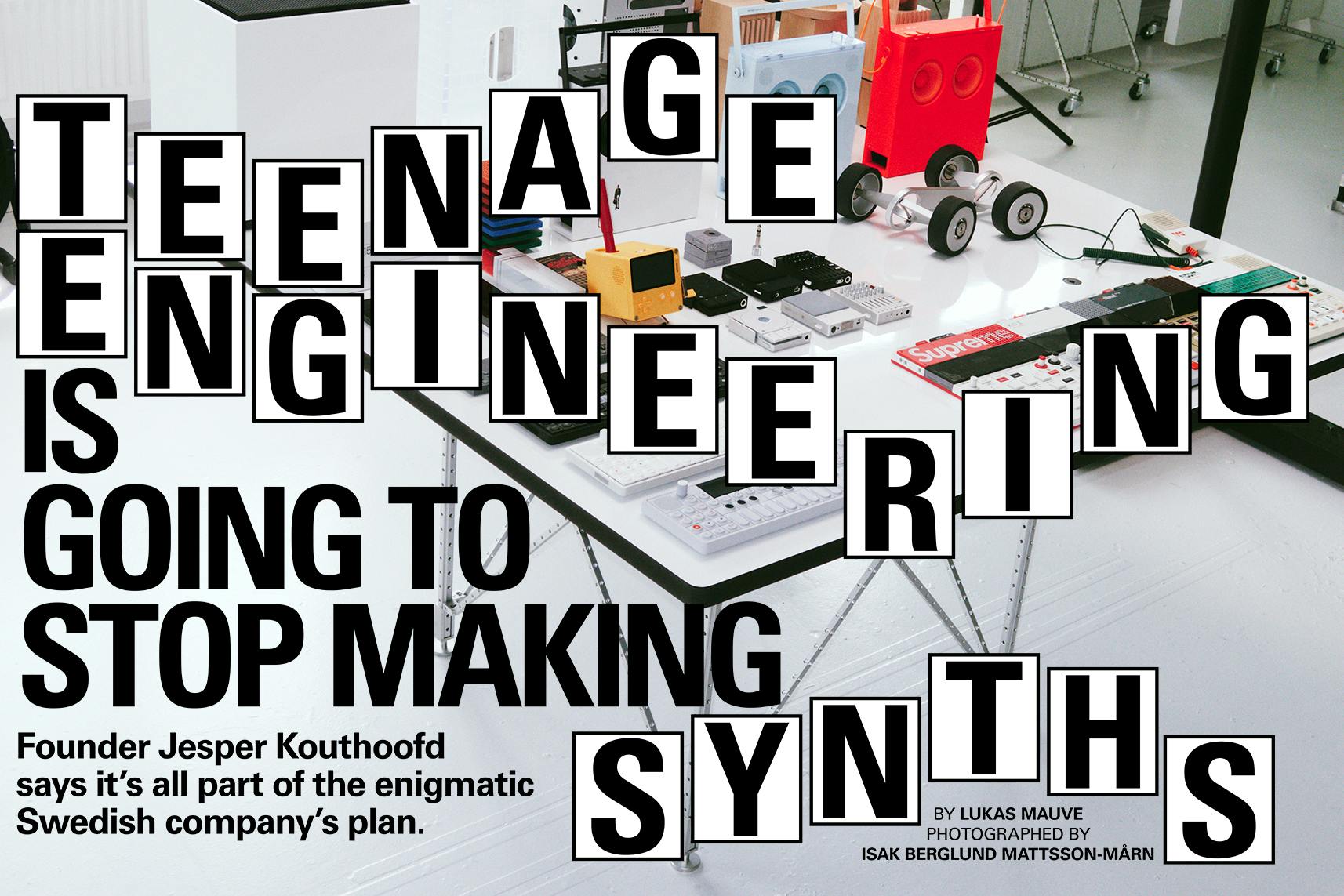
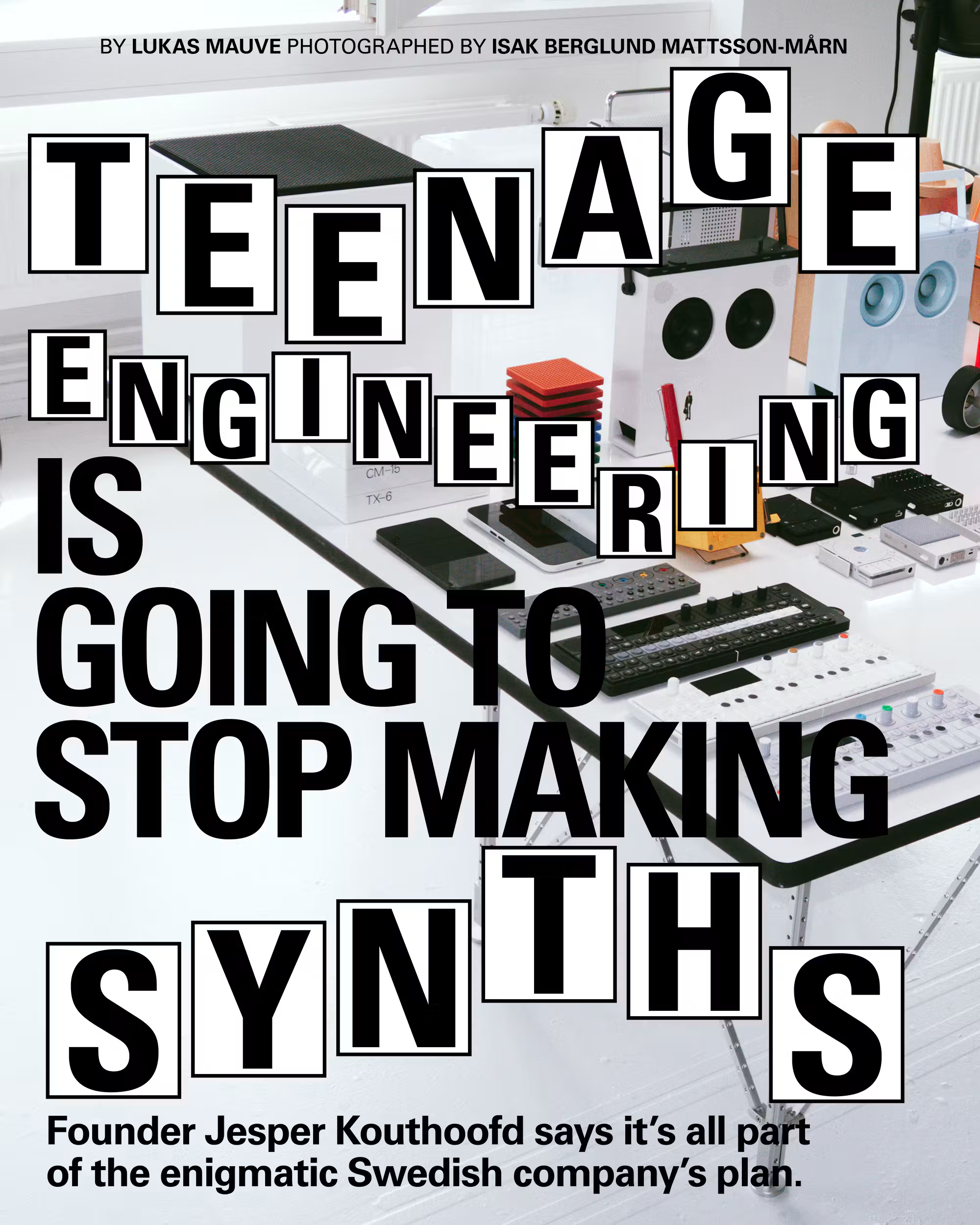
The products that teenage engineering puts out combine minimalist industrial design with a quirky, almost childlike sense of humor. There’s everything from audio equipment to a portable vinyl record cutter, a tape dispenser, and a $2,000 choir of eight wooden dolls singing choral classics. The OP-1 is known for its cartoonish user interface. It features a cow whose four stomachs visualize different delay effects; launching the sequencer shows the phrase “Marx was right.” One groovebox, the EP-1320, uses Old English fonts and Latin labels and comes preloaded with hundreds of medieval samples, including lutes and Gregorian chants.
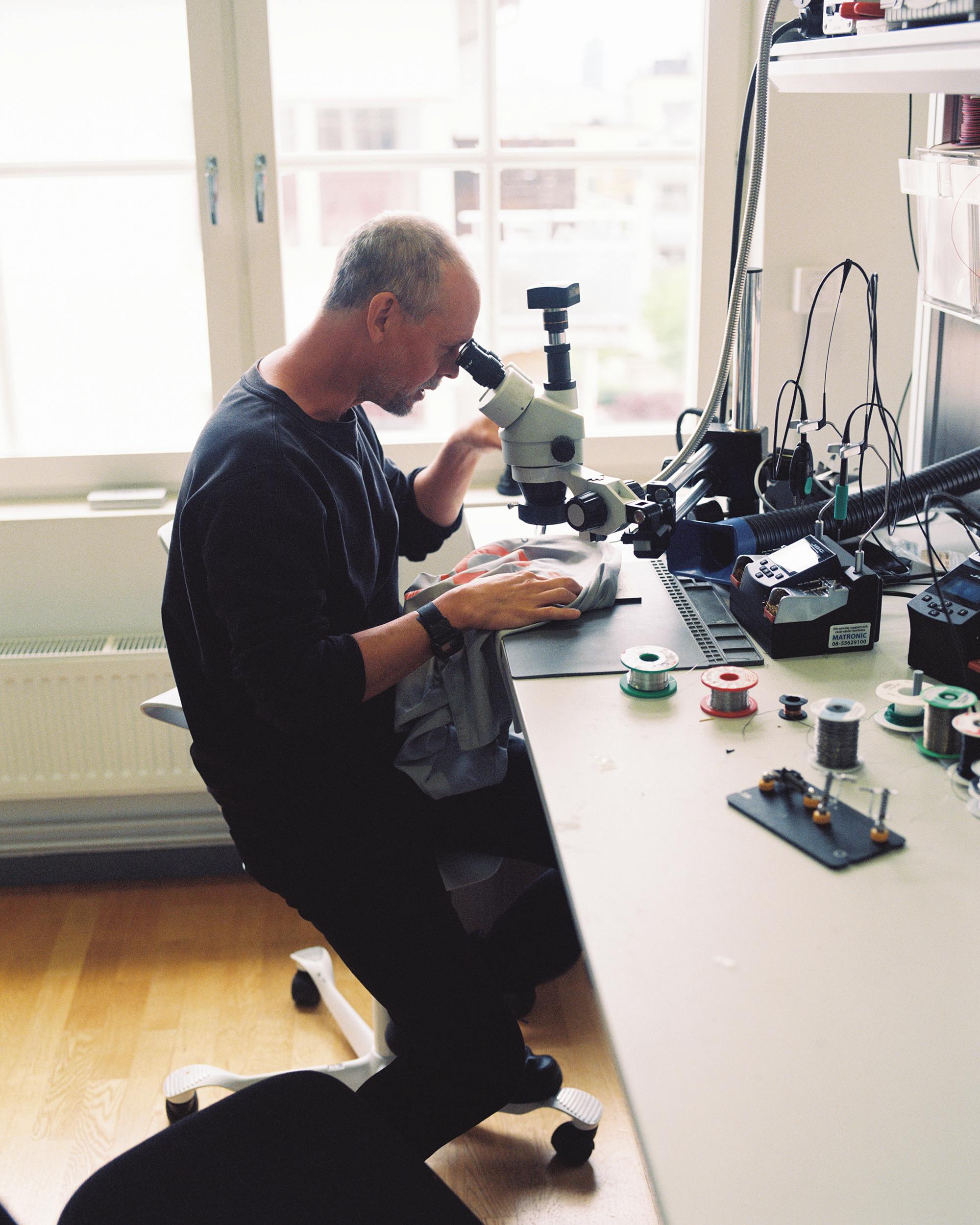
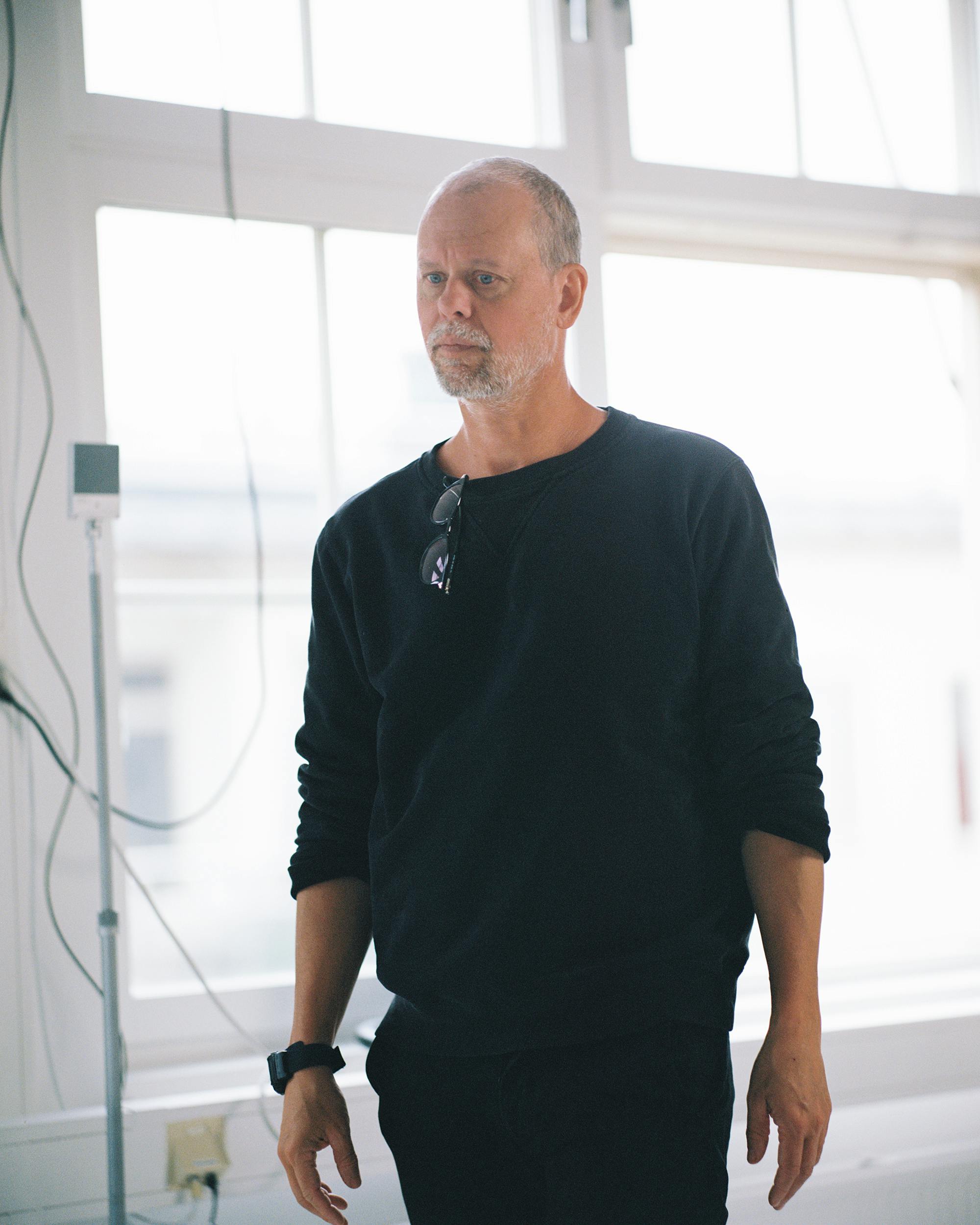
Kouthoofd in laboratory mode at the company’s Stockholm headquarters.
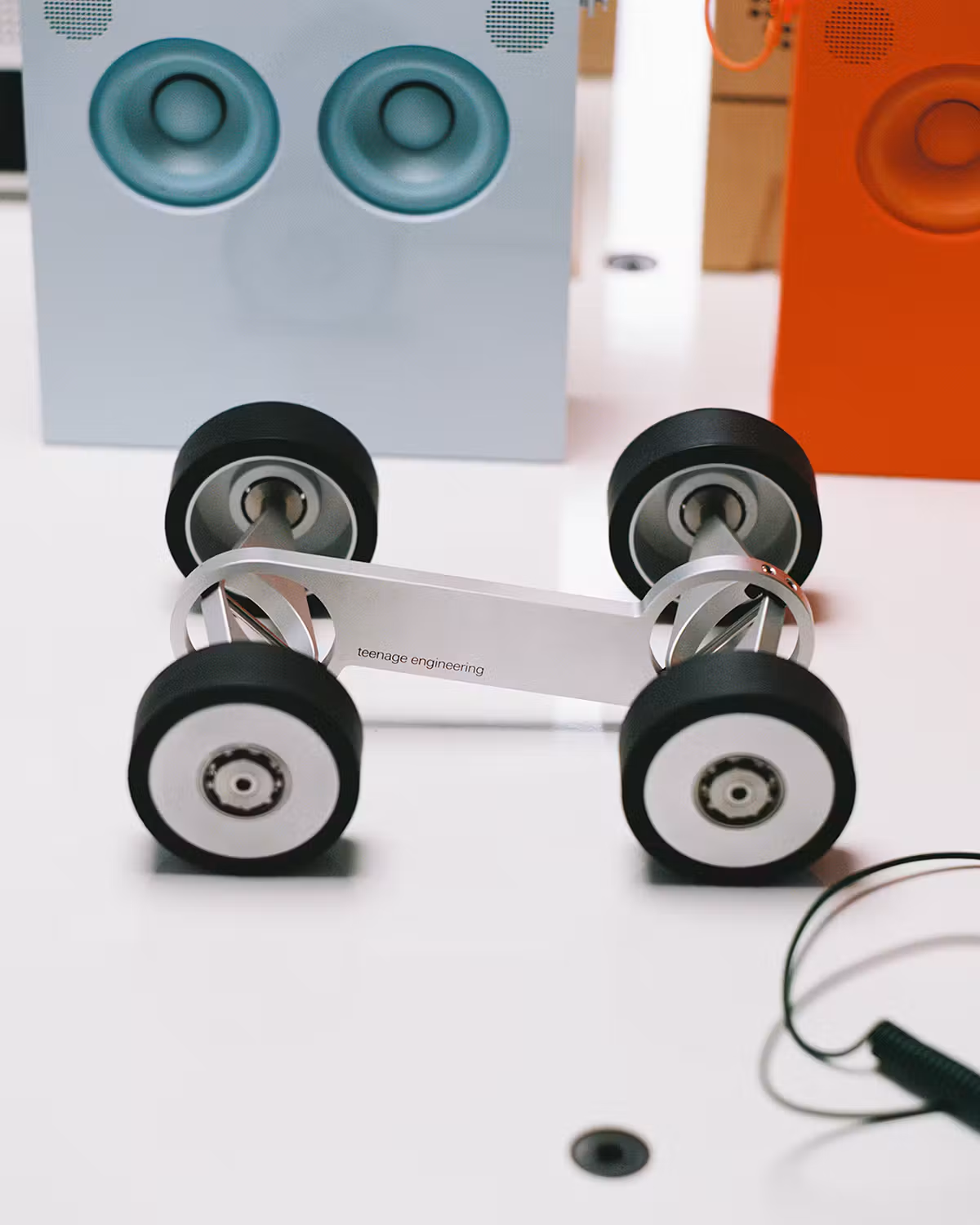
teenage engineering’s Grip Car, designed by Danish designer and longtime friend of the brand Anders Hermansen.
“Often,” Kouthoofd says, “when a product may not be reasonable or probably won’t be profitable, it’s good to just put it out there, see what happens.” That same mentality lets teenage engineering move easily from a sampler with Supreme and a DJ deck designed for the late Virgil Abloh to products that end up on bedroom desks and in home studios. As one Reddit user puts it: “Maybe teenage engineering is a collective of ingenious yet devious trolls who exist solely to make the online community seethe.”
When I read that comment to Kouthoofd, he laughs. The mischievous look in his eyes reminds me of my high school chemistry teacher who loved proving that people only call something a miracle when they don’t understand how it works. Kouthoofd and I have just sat down on two big black floor chairs at teenage engineering’s headquarters in Hammarby Sjöstad, a former industrial waterfront transformed into a showcase of Scandinavian urban planning. “There’s no hidden secret to what all this is,” he says, pointing to a table covered in teenage engineering products, some yet released. “In fact, it’s almost too obvious. I’m the son of a Dutch architect father and a Swedish banking mother. I grew up watching him draw and her doing big business. Honestly, I see myself as the perfect 50/50 combination of my parents.”
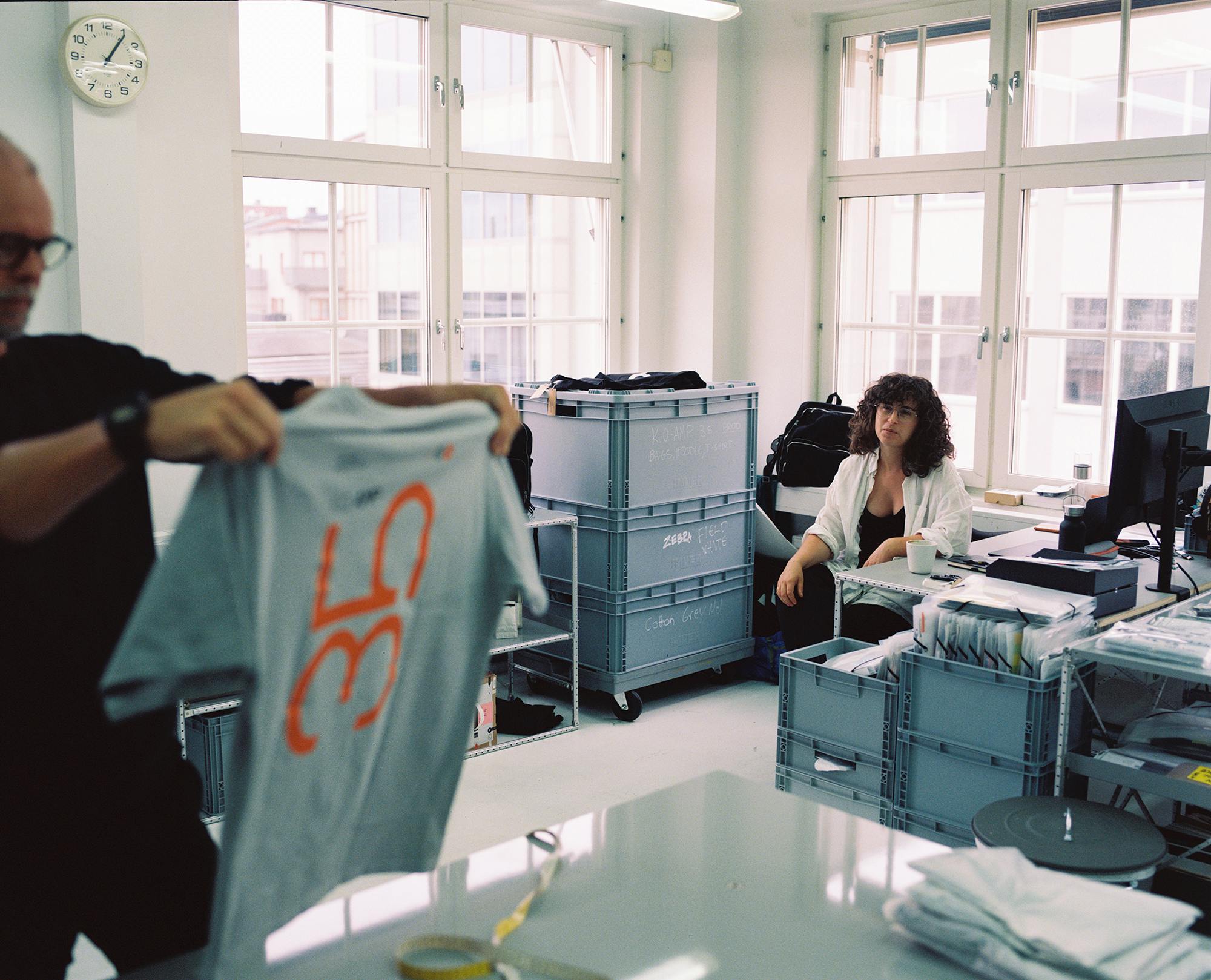
These days, at 56, Kouthoofd is the CEO of a company with roughly 100 employees and annual revenues of around $46 million. He has enough resources and experience to run it exactly the way he wants — as an extension of childhood Saturdays spent building electric kits from the local store in a village on Sweden’s west coast.
Kouthoofd is an unconventional leader. He doesn’t like spreadsheets or customer surveys. He’s not afraid to call himself authoritative. His time as one of the founders of Acne Studios, the major fashion house that started as a multidisciplinary studio, taught him that a company isn’t a “democratic organism. It needs a strong voice that can say yes or no.” It means, for example, that out of a hundred prototypes, Kouthoofd decides which one makes it to market, even if the team has calculated that it won’t sell. “We have a plastic PC case that you can build your own PC in. I wanted it to be $10,” he says. “Everyone said that was impossible because it cost $10 just to make. Then I said, ‘We won’t sell it, we’ll give it away for free. Now you don’t have an argument anymore.’”
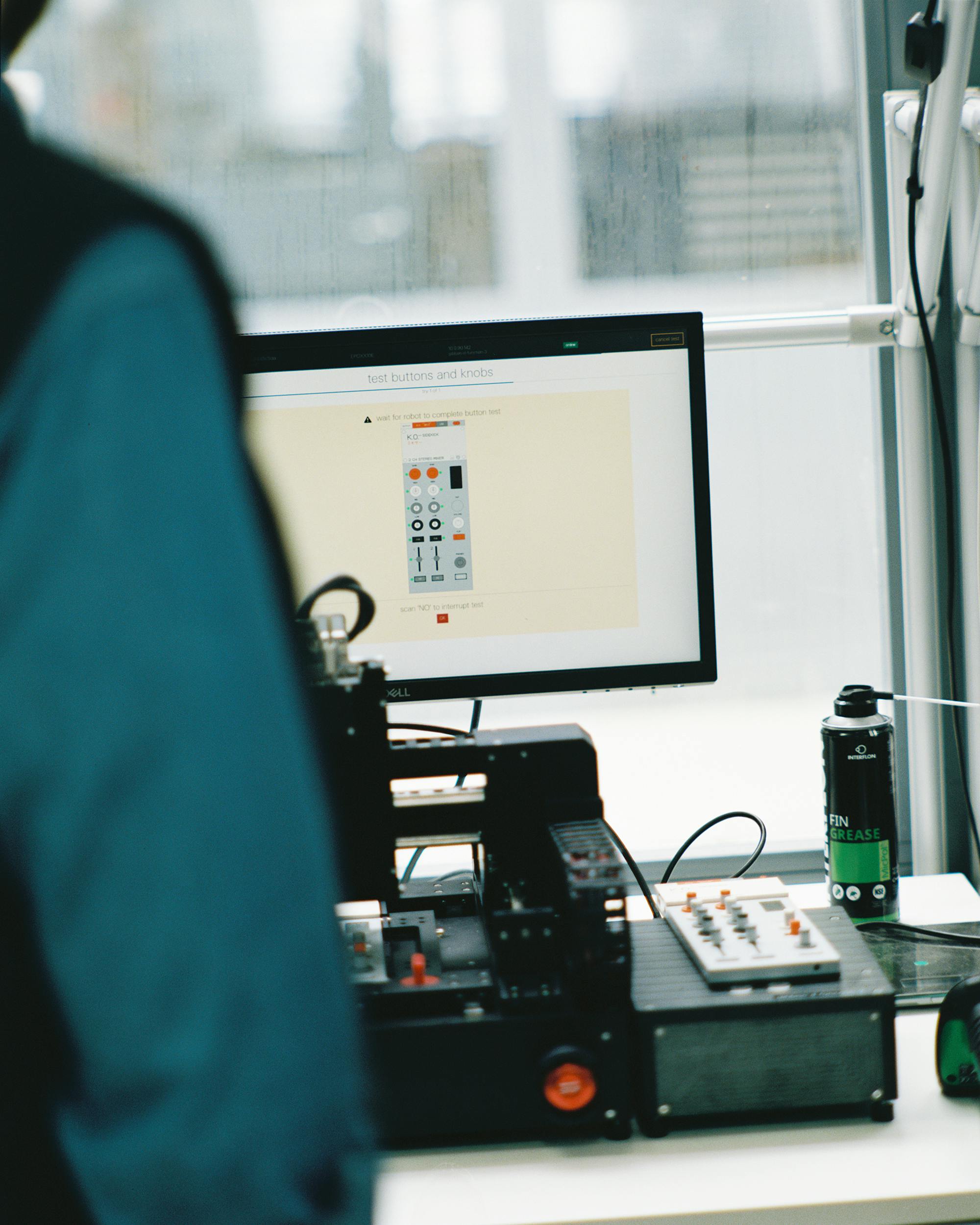
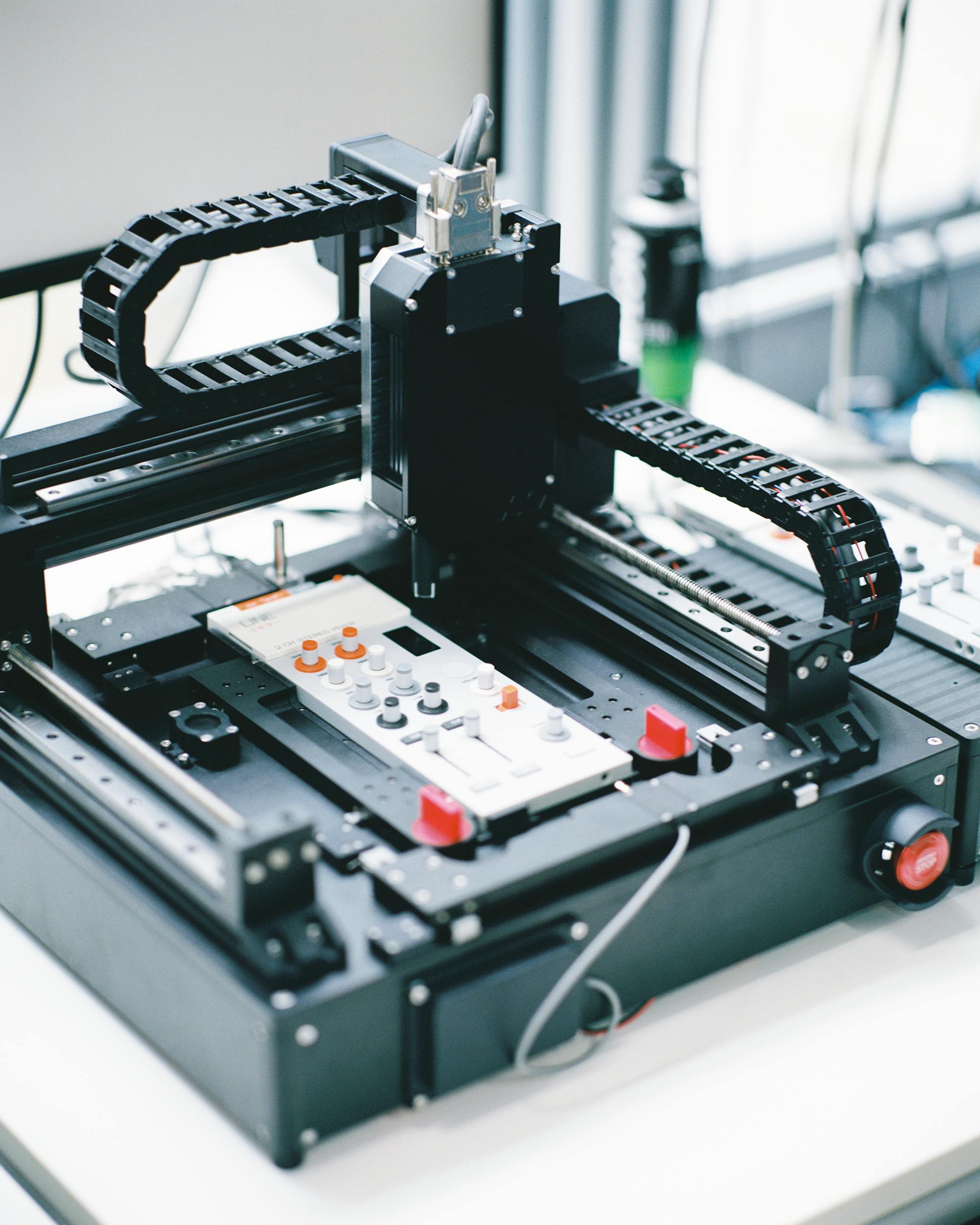
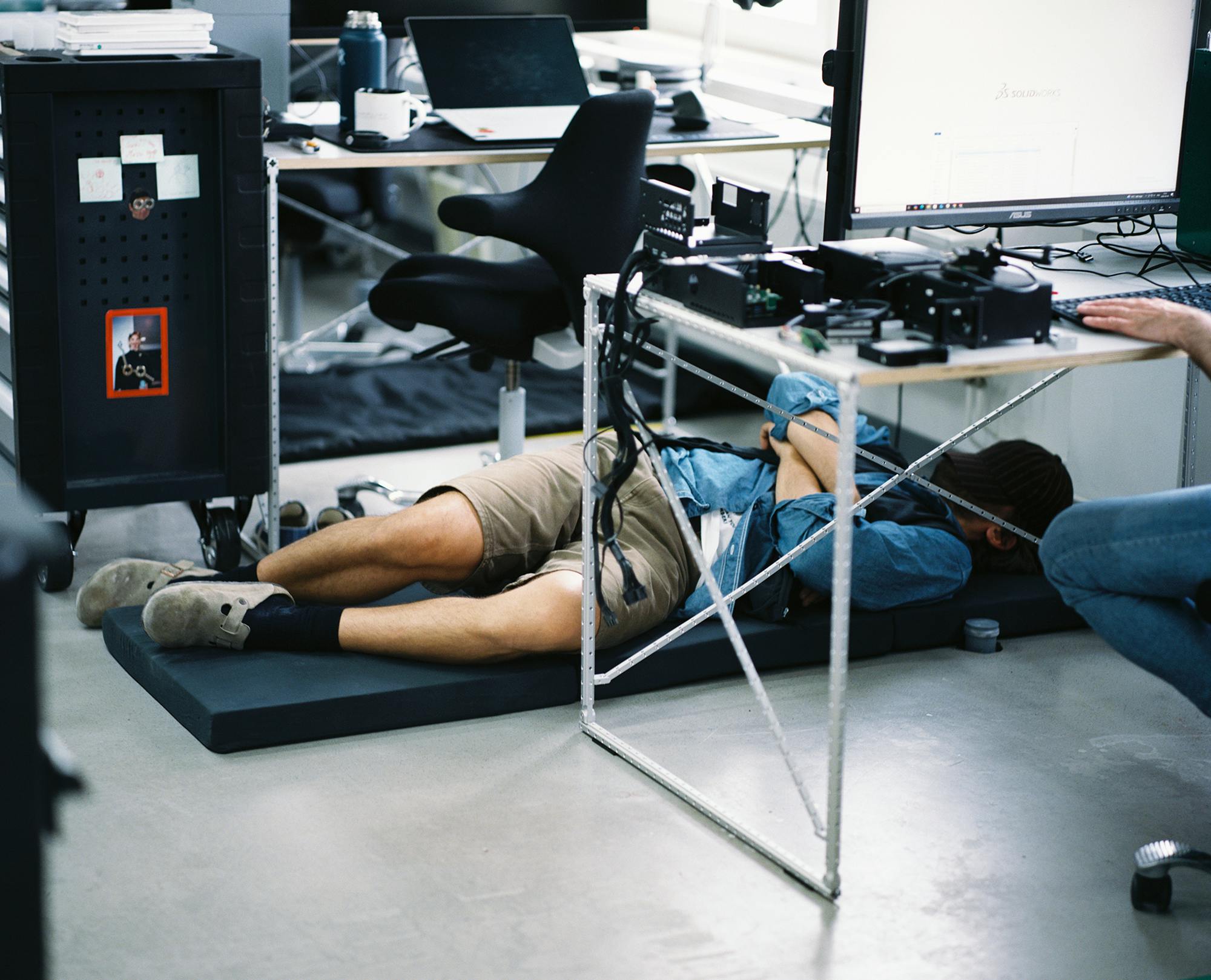
A testing setup inside teenage engineering’s headquarters.
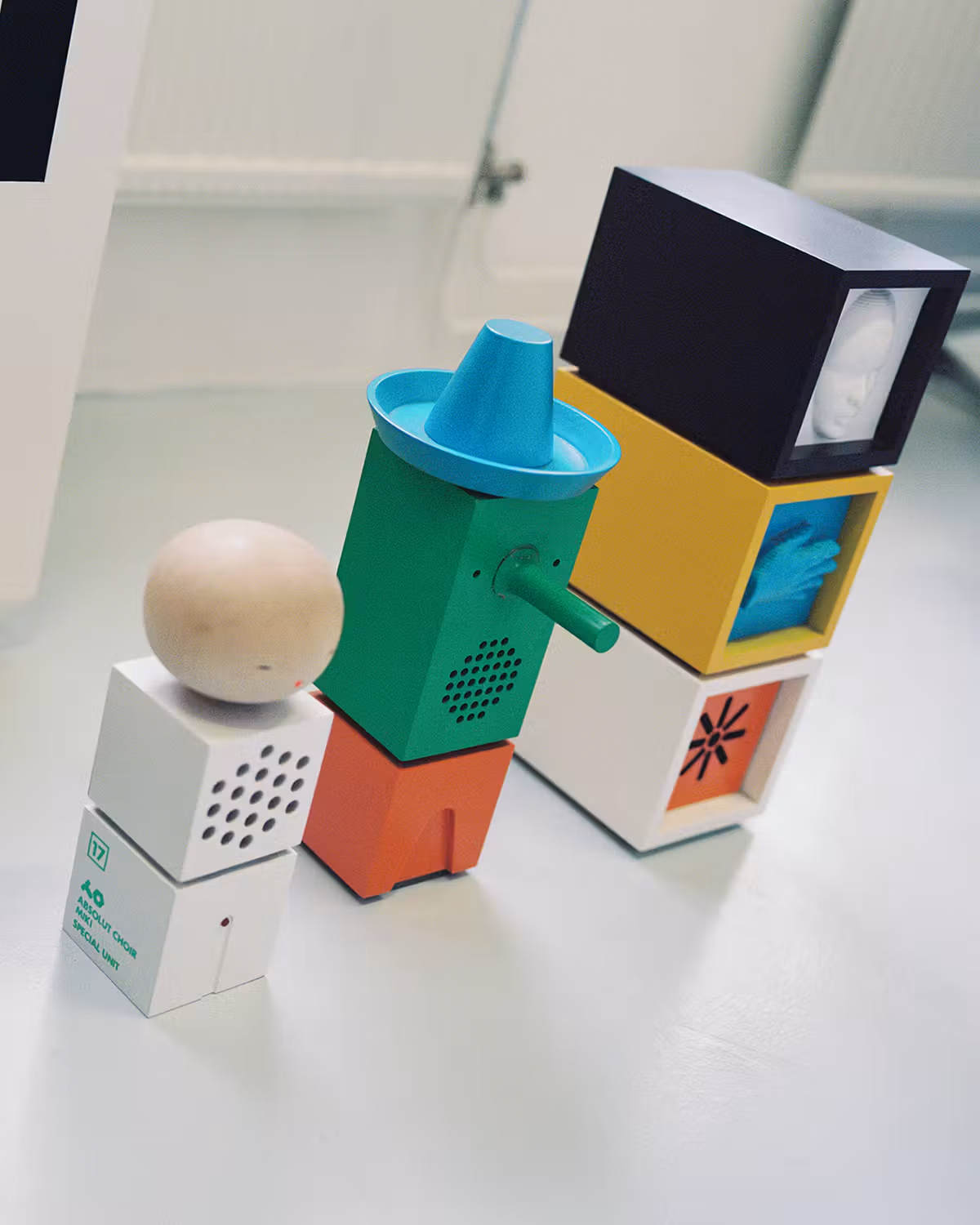
A selection of teenage engineering objects, including members of its “Choir.”
This kind of leadership can be tough to deal with. “It happens all the time,” says Yi-ying Hsieh, a Taiwan-born industrial designer who has been a core member of the design team for the past six years. “I spend weeks working on something, and then Jesper comes in, takes one look, and goes: ‘No, that’s ugly. Don’t do that.’ I’ve had to see a therapist because of it,” she adds, only half-joking. By now, she thinks her job is the best in the world. “teenage engineering is Jesper doing what he wants to do,” she says. “But we’re all okay with that because we want to contribute to what he wants to do.”
Although he’s a top-down leader, Kouthoofd is deeply involved in the day-to-day creative process. The early stages usually take place over lunch or an after-work beer. “I overhear someone saying, ‘Wouldn’t it be cool to have a unit like this?’” Kouthoofd says. “If it sounds interesting, I’ll run home straight away. I have a woodshop, 3D printers, a sewing machine — everything. I’ll make a model, bring it back to the office, and say, ‘Is this what you had in mind?’”
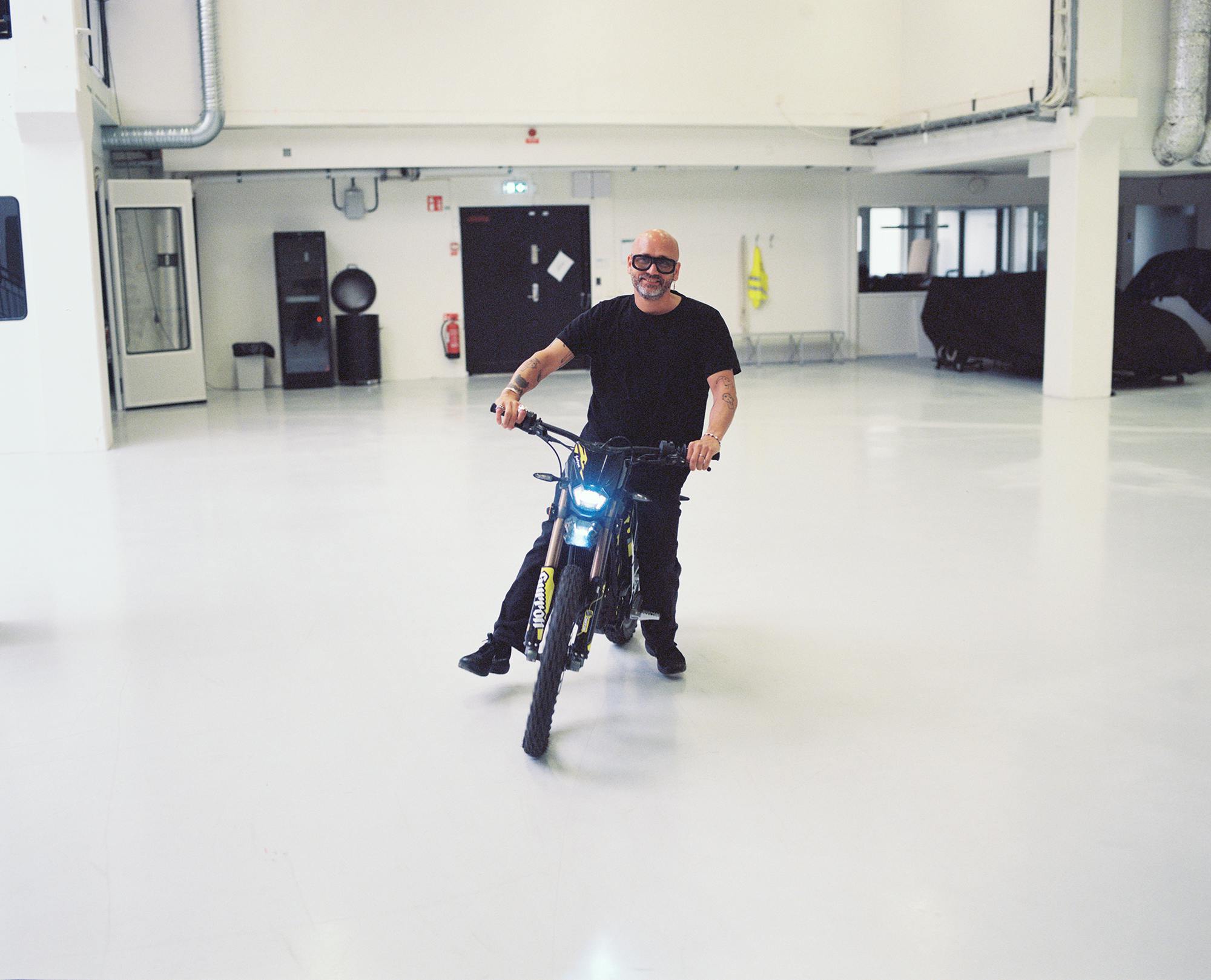
To show me what happens in the next stages, Kouthoofd stands up from his chair and walks me through a door usually locked to visitors, marked with red-and-white “no entry” signs. Behind it, the space shifts from corporate office to something laboratory-like: wires and screwdrivers everywhere, machines humming, robots running functional tests, and young engineers and programmers working in concentrated silence, some at workbenches, others behind screens. “Some of this won’t be released for five to 10 years,” Kouthoofd says, pointing to a new project he believes will change our online life.
Hsieh, searching for a way to capture teenage engineering’s typical way of working, offers a metaphor: “If you asked anyone before the invention of the car what they wanted, they would say: ‘I want a faster horse.’ They wouldn’t tell you they wanted a car because it didn’t exist yet. Other companies I’ve worked at try to make a faster horse. Jesper tries to make a car.” It fits Kouthoofd’s partly boyish, partly visionary ambition to create products that don’t answer a demand or solve a problem. “Otherwise, what’s the reward except money?” he says. “I want to make objects that comment on, or raise questions about, why we accept things as they are.”
“teenage engineering is Jesper doing what he wants to do,” she says. “But we’re all okay with that.”
Yi-ying Hsieh, teenage engineering designer
That also applies to the OP-1 (and its successor, the OP-1 Field). Born in Kouthoofd’s garage, it’s used by artists as disparate as Aurora, Mike Dean, and Jean-Michel Jarre. Fifteen years after its launch, it remains one of the most sought-after instruments on Reverb, the world’s largest online marketplace for used music gear. Not bad for a pocket-size, battery-powered device Kouthoofd calls a protest against making music on laptops — less software-driven and serious, more intuitive and fun. More fundamentally, he says, it’s a rejection of the illusion that most synthesizer companies sell: “Ninety-nine percent of people who buy synths don’t use them as a productive tool for making music. It’s therapy. It’s entertainment. It’s a hobby. That’s what the OP-1 is. The first version didn’t even have an undo button.”
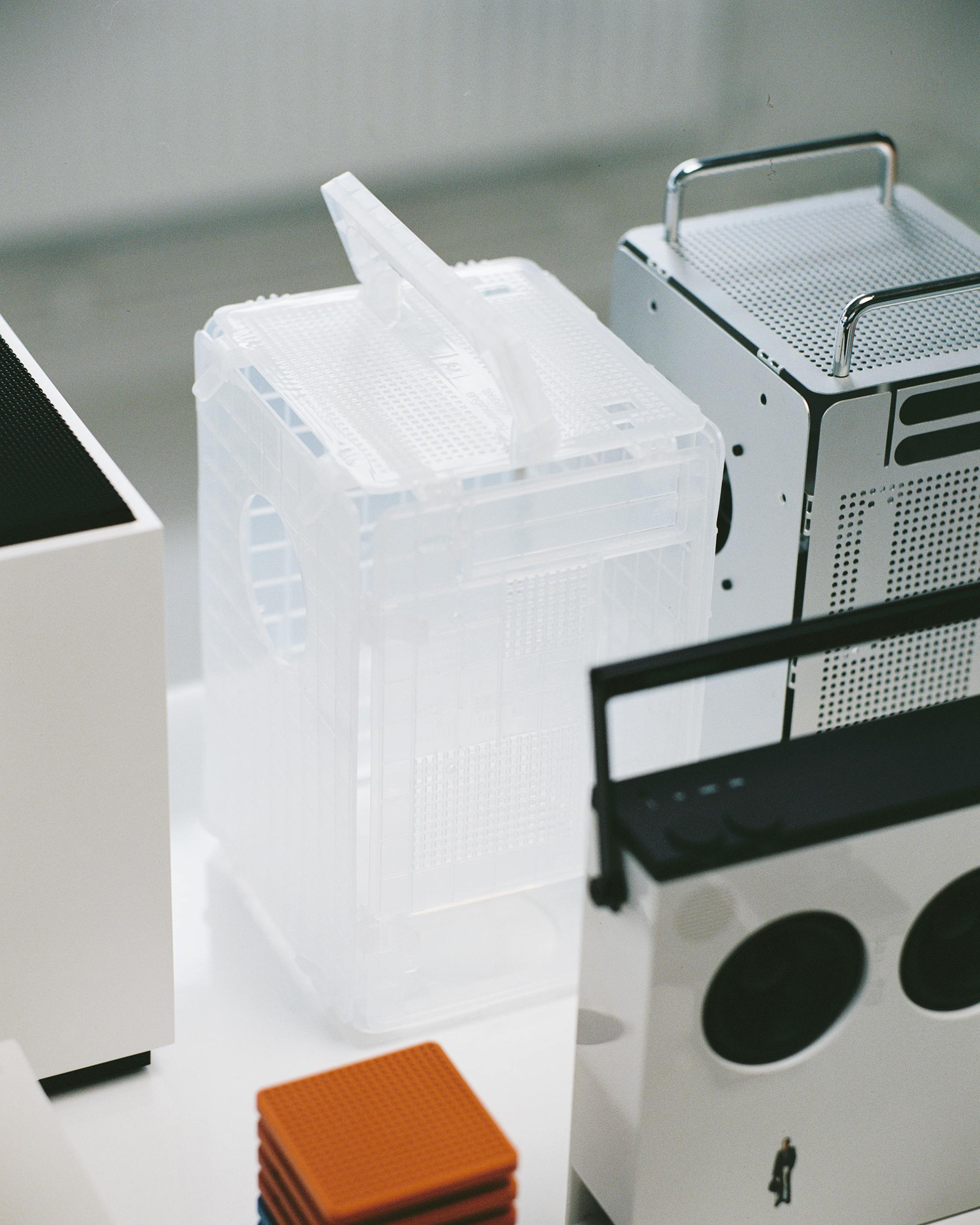
A semi-transparent computer case cut from a single sheet of polypropylene that folds and snaps together without screws or tools.
“Think of it this way,” says Parisian musician and digital artist NSDOS, whose real name is Kirikoo Des. “Like an Apple device, some instruments think for you. The OP-1 is like Android or Linux: harder at first but also more free and creative, allowing you to put your own thinking into it.” Once he went down the rabbit hole of its workflow, the OP-1 became crucial to his experimental techno, which mixes organic sounds with industrial beats from custom-built hardware.
“teenage engineering is a point of view more than anything, and that’s what I resonate with the most.”
Lykke Li
He is far from alone: NSDOS is part of a global community of musicians, producers, and DJs formed around teenage engineering who use its gear everywhere from Berlin studios to Tokyo live sets. Lykke Li listens to her demos on a teenage engineering speaker while lying on the floor of her Los Angeles home. “It compresses [the audio] in a way that allows you to keep dreaming about what to add rather than freaking out over what’s not there,” she says. She cites the design as a draw, but also Kouthoofd himself and “how he thinks about things.”
“It’s like one big family at this point,” she says. “I feel like teenage engineering is a point of view more than anything, and that’s what I resonate with the most.”
The OP-1 has made teenage engineering what it is. Counterintuitive as it sounds, that’s precisely why leaving it behind is the most teenage engineering thing Kouthoofd could do. He doesn’t want the company to be pigeonholed as a producer of synthesizers. In fact, he doesn’t want it to be defined by any single product at all.
For Kouthoofd, teenage engineering is its own most important creation. “We shouldn’t make profits out of the products,” he says. “The real value lies in the company as a whole.” He no longer wants ideas to take the form of “obvious end products” — like, say, another synthesizer.
More simply, he wants teenage engineering to be a place where people never get bored. “What’s the point of going to work,” he asks, “if it isn’t fun?”