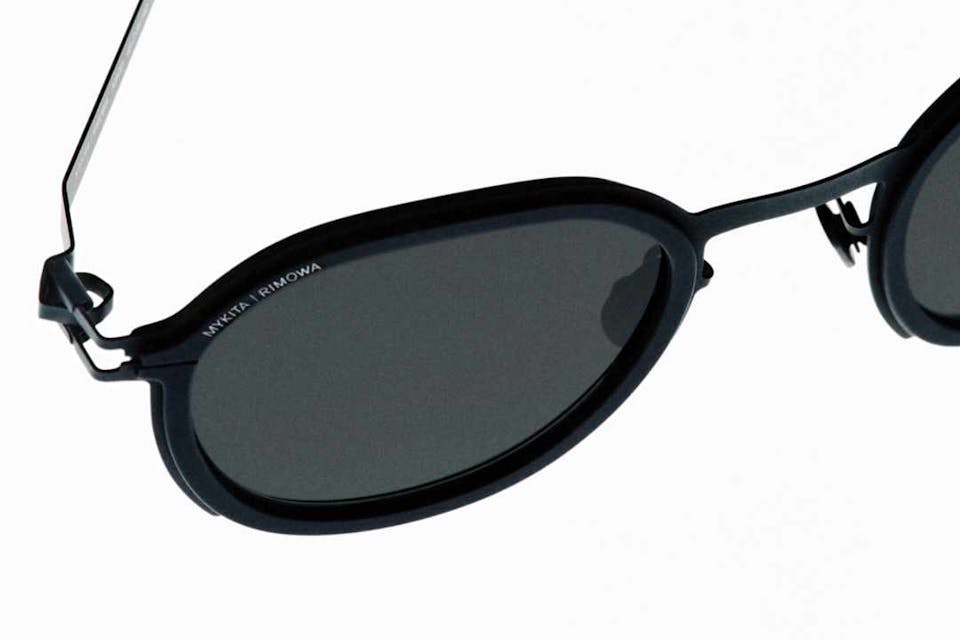
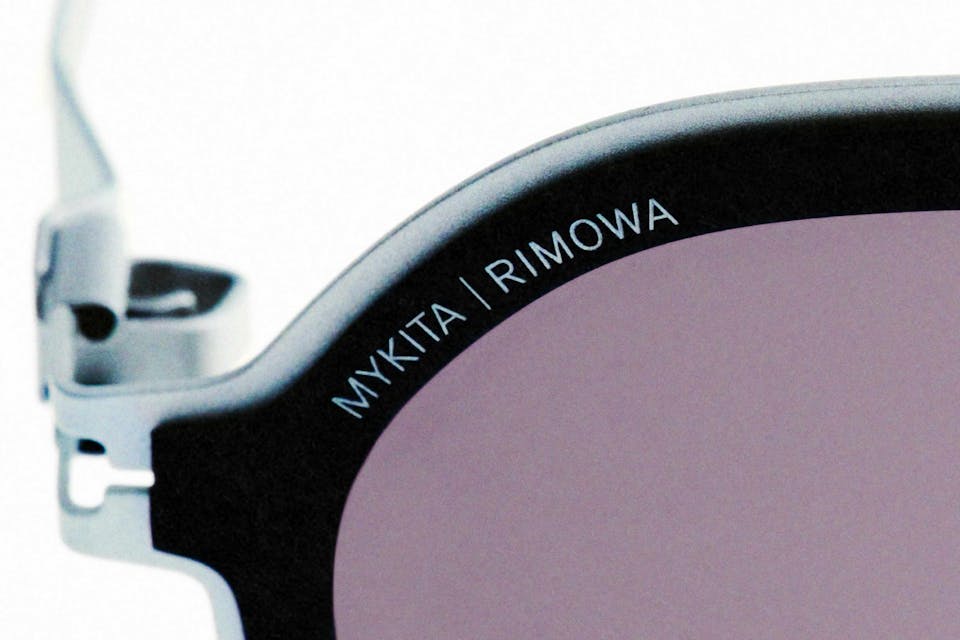
After almost two hours of walking around MYKITA’s new Berlin hub, soundtracked by the satisfying “pop” of artisans pushing lenses into their frames and the whirring sound of heavy-duty machinery at work, we’ve reached Moritz Krueger’s favorite room. The MYKITA founder, dressed casually in spotless white norda 001 sneakers, loose-fitting NEEDLES track pants, and a skintight black long-sleeve tee, is ushering me into what he calls the “research & development workshop.” However, a more apt name may be “torture room for glasses.”
I'm being shown around the new MYKITA headquarters, or MYKITA HAUS, opened in November 2024 inside an old red brick building next to Berlin’s Spree River. This place is part workshop, part warehouse, part design studio and every pair of MYKITA glasses is designed and manufactured here. Or, should I say, designed and tormented here. In the research & development workshop, MYKITA engineers are operating custom devices that repeatedly bend and contort frames into painful-looking shapes that’d snap most glasses like a toothpick. If I was a pair of glasses, I'd be terrified.
The German eyewear industry's standard eyewear durability test opens and closes the glasses' temple, the long arm that wraps around the ear, about 10,000 times. But nothing about MYKITA is standard. Here, glasses undergo an even more brutal temple-stretching exercise around 100,000 times. And, instead of opening to a 90° angle, the temples are overextended to 120°. And that’s just the start. Next comes a contraption that makes the temples spin around and bend backwards like tiny demon-possessed contortionists. “This is really awful for our product,” laughs Krueger.
But that’s the point: if these glasses can’t handle truly awful treatment, they’re not worthy of the MYKITA name.

These tests are just one small part of MYKITA’s elaborate production process, where Krueger estimates 50 prototypes are necessary to land on a final product and over 80 manual steps are needed to produce a steel optical frame. This fastidiousness is indicative of the philosophy behind the spectacles. “When MYKITA started, the eyewear industry had been static for decades. A few major manufacturers were producing frames much the same way since the 1930s — same materials, same methods,” says Krueger. “Our starting point was to treat eyewear as industrial design, to rethink every element based on its purpose and material logic.” That mindset hasn’t changed, but the technology has improved.
Krueger likes to keep as much of the production in-house as possible. He doesn’t trust outside companies to cut MYKITA's top-of-the-line lenses, for example, so he bought his own lens-cutting machines. Krueger's diamond knife is sharpened more regularly than at lens suppliers, he says, since they're always looking to keep their costs low. “If you own the technology, you decide what is important,” says Kreuger. “You can change small parameters and make it better.”
Around 240 people work in the Berlin base, over 110 of them being artisans who hand-assemble every pair of glasses. They perform a vital role, which Krueger illustrates through some very specific numbers. “Maybe 17.9% of [our] work is the idea and the creativity, the remaining 82.1% is execution,” he says. “Choosing the ingredients — materials, shapes, colours, detailing — is the easy part. After more than twenty years, we know how to expertly tailor eyewear to different physiognomies.
"The real challenge is bringing a design into serial production in-house at the standard we expect and are known for. We’re operating at a kind of Champions League level,” Krueger continues, referencing European club football’s most prestigious tournament. ”Every piece has to meet that benchmark.”
In the MYKITA workshop, there are no screws or glue or soldering irons in sight. MYKITA engineers every element of its glasses to slot in place through cleverly designed hinges, making the final product surprisingly lightweight, even more surprisingly durable and easy to repair. Once the lenses have been popped in, the temples attached, the silicone nose pads slid into position, and the artisans finish tweaking everything using their many various pliers, a quality inspector quite literally signs off on every pair with a card that comes with all of MYKITA’s glasses.


When the company was founded in 2003, it originally utilized the flexibility of stainless steel to create its screw-free lenses. Over time, it slowly added to its material arsenal through renewable acetate and MYLON, an award-winning and patented 3D-printing technology developed by MYKITA. “The beauty [of MYLON] is you have basically no restriction in the design,” says Krueger. Through a process called selective laser sintering, typically used to create prototype parts for car engines, a polyamide powder is transformed layer by layer into a solid material with a distinct grainy texture that’s 30% lighter than acetate. And, because this is MYKITA, MYLON is as airy as it is remarkably sturdy.
Typically, MYKITA sticks to materials that it can shape in-house. But occasionally, it’ll partner with the rare manufacturer with equally exacting standards.

Recently, these companies have happened to be fellow bastions of German engineering, such as Leica, the high-end 156-year-old camera company, which sporadically lends its advanced lens technology to MYKITA glasses, as well as suitcase maker RIMOWA, which, following four years of testing, worked with MYKITA to create glasses utilizing the aluminium from its famously hardy suitcases.
“Our focus in the last four or five years was working with more companies [that bring] something real to the table,” says Krueger. “These are collaborations, but realistically, it's a real transfer of manufacturing and design know-how from both sides.”
Not to say MYKITA will stop working with fashion brands: its previous collaborations with labels like Maison Margiela and magazine-turned-fashion-label 032c are some of its most recognizable works. It simply means that the eyewear label is looking for partnerships that extend beyond aesthetic upgrades.
After all, MYKITA’s practice has always been about far more than aesthetics. “In the end, eyewear is about integrity,” says Krueger. “Every element should have a purpose, and we prefer to keep that logic visible. If the construction is honest, the finished frame feels effortless.”
Highsnobiety has affiliate marketing partnerships, which means we may receive a commission from your purchase. Want to shop the products our editors actually love? Visit HS Shopping for recs on all things fashion, footwear, and beauty.